It took a lot of play testing, and taking it out for a spin at a couple of game conventions, but finally the expanded and refined Combat Toolkit is here.
One reason for the big upgrade, that went from less than 20 pages to nearly 40, is that combat features heavily in Electric Gods, and the types of combat is wide and varied, with weapons ranging from a pointed stick to a futuristic blaster pistol, flying combatants, fights while jumping from branch to branch in the jungle canopy, and hand to hand combat on conveyor belts leading to a reclamation furnace.
All us Gamers is not a table top wargame. It is a roleplaying game. Making a system for combat that honors the distinction is not easy, and the temptation is to either go very mechanical, or entirely improvised with GM rulings.
Instead what is here is a mechanical system that gives some concrete, mechanical outcomes, embedded in an action narrative framework.
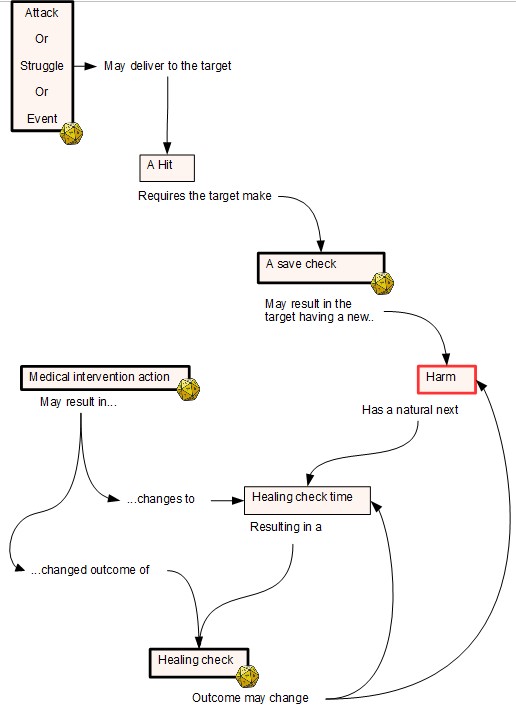
It now has a number of explicit harm types, rather than just injury, such as stings, tranquilized, paralysis. It makes poisoning a process that repeats a harm over time. That mechanism would be easily applied to diseases and radiation poisoning as well.
Medical intervention is tighter and smoother. It primarily allows the medics to create a group result that modifies the patients healing checks, using the system from the Inner Core.
There is a guide for weapon types and armour, giving difficulties for producing a hit, strength of application of a hit, modification of saving throw difficult by armour type, and a section on explosions for those that want grenades through to atomic blasts. This section is not comprehensive but models enough that anything else you want to add can find guidance here.
Importantly there is a set of formal “hand waving” rules that show ways to simplify, remove features you don’t feel like using and reduce game master and player book keeping. These rules have names like “Action Movie”, “Boss, Minion, Extra” and “Time Waffle”.
That is the simple mechanical process that drives the show. The art of the combat comes from its integration with the struggle and operation tools, allowing each moment of combat to be about achieving something, maneuvering, suppressing opponents, preventing and achieving operational goals and so on.
While the combat toolkit is undergoing a big overhaul and games are being played regularly as well as at conventions, the bestiary is being developed.
While the combat toolkit is undergoing a big overhaul and games are being played regularly, as well as at conventions, the bestiary is being developed.
Unlike lots of games where its all about stat blocks, this is about the role of the creatures and their behavior.
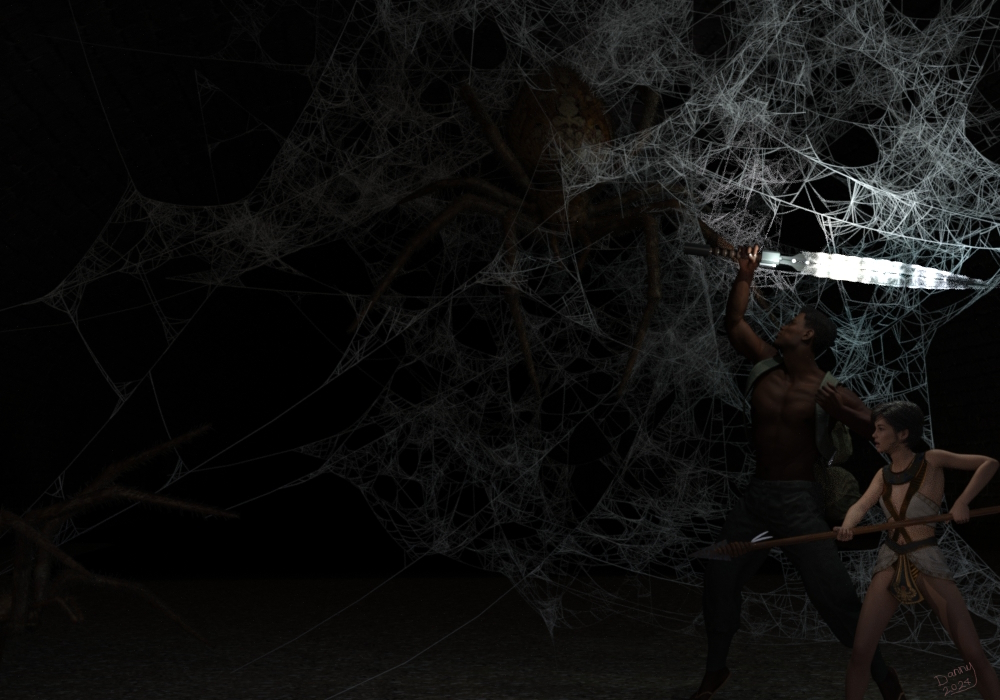
For example, take Tunnel Spiders. Their bodies are the size of large dogs. They have a built in instinct to hoard AcSticks, programmed into them long ago by the “gods” that developed them. A group carrying a lot of AcSticks are likely to be targeted by tunnel spiders that might otherwise leave them alone.
They also have an instinct to ignore a certain breed of scorpion, the size of a person’s hand, that can snatch AcSticks from the hoard and take them off to a collection place.
The spiders can move twice as fast as a running human, for about 3 combat moments but then they tire and will stop a pursuit.
Their poison is dangerous, with 2 repeat hits after injection, one each moment.
Their attack aptitude is 4. Their aptitude for hiding in dark spaces is 6.
Webs are built to capture creatures up to the size of a cat. They only slow humans down. The spiders build communal webs, with a mix of a dozen smaller spiders and one to three larger spiders. The larger spiders will often brush aside the smaller spiders and their webs to go after a good prey. What looks like egg sacs in the webs are often wrapped up collections of AcSticks, up to 1,000 per sac.
That’s it. There isn’t much need for anything else.
BrizCon once more is on the horizon, May 4 to May 5.
A new adventure with a new tribe will be the highlight om Sunday 5th at 10am.
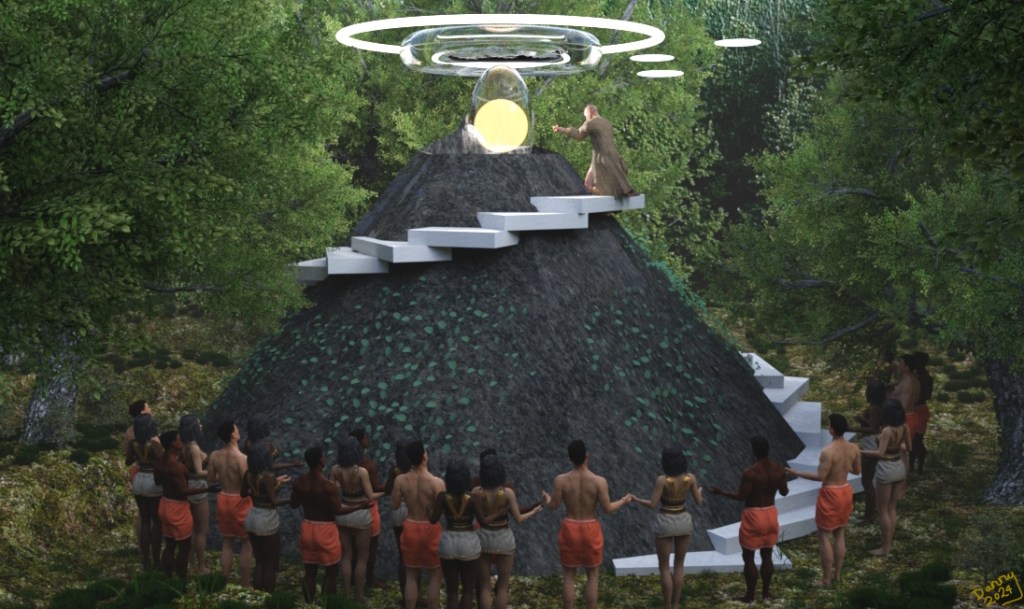
The tribe has lived in the safe caves of the Jungle for generations. They are the People of the Pale Flame. The dead are dangerous as they get up and walk again if not properly interred. The Magnificent God UnochNuNuf accepts the scant few precious AcSticks the tribe can spare to purify the dead, with the altar god DohTreZen performing the rituals with three glowing altari in attendance and the sound of the great sanctuary host calling the spirits to rest.
To the tribe’s horror the Demons from the Death Spires have disturbed the embalmed bodies, lying in the ancient hover cars in the crypts below. Soon the undead shall stir in an irrepressible army if some brave souls do not delve into the great crystal globes of the Death Spires, to bring back enough AcSticks to gain the protection of the Gods.
Be brave! Beware the unhumans! Trust no apparition!
This is a road map for the release, no dates attached. Hopefully at least two new releases within 2025. This page will update as things advance.
– version 1.2 of On Aptitude (Released 2024 04 01 🙂 )
– version 1.2 of the Combat Toolkit (Released 2024 12 20 🙂 )
– Initial release of the Electric Gods base set (will incorporate The Jungle) set for early 2025
-Initial release of Electric Gods : The Death Spines, an expansion for The Jungle.
– Initial release of Electric Gods : Terribilis Arbores, the world expands with a whole new location and environment.
This is a road map for the release, no dates attached. Hopefully at least two new releases within 2025.
This page will update as things advance.
version 1.2 of On Aptitude (Released 2024 04 01 🙂 )
version 1.2 of the Combat Toolkit (Released 2024 12 20 🙂 )
Initial release of the Electric Gods base set (will incorporate The Jungle) set for early 2025
Initial release of Electric Gods : The Jungle (Now incorporated into the base set).
Initial release of Electric Gods : The Death Spines, an expansion for The Jungle.
Initial release of Electric Gods : Terribilis Arbores, the world expands with a whole new location and environment.
This contains the premise of the game, all the rules needed for making an appropriate character, the setting data for the game master, and how to create your campaign. The examples will all be drawn from the Jungle setting used in the current play tests.
The adventures revolve around characters, pure humans or human sports with strange gifts, living in apparently primitive tribes.
However the gods, strange presences of glowing light hovering above the tribe’s altar, can bestow upon the tribe gifts of food and clothing, and equipment ranging from simple gardening tools to chain saws, bows and arrows through to plasma rifles, and healing medicines and technology. All the tribe has to do is supply the gods with the little white AcSticks found scattered about.
But in the wilds, beyond the protection of the gods, there are monsters of many kinds. The worst also crave the AcSticks and many will kill to gain them or keep them.
And worse still than the monsters? Other tribes, some human, some near human, some strange and exotic. Each other tribe has its own culture, its own desires, its own hatreds. Deal with them as you dare!
Survival, mystery, action, adventure, politics, all rolled into one spell binding role playing setting.
Electric Gods : The Jungle
A detailed version of the play test setting with a mountain of information about groups, the territory, equipment lists, gods of the jungle, a creature codex, some starter adventures and more.
Now incorporated into the Base Set.
Electric Gods : The Death Spires
An Expansion for Electric Gods : The Jungle
In Electric Gods : The Jungle the city is placed and described well enough for a game master to roll their own version and run with it. This module is for those game masters that want more.
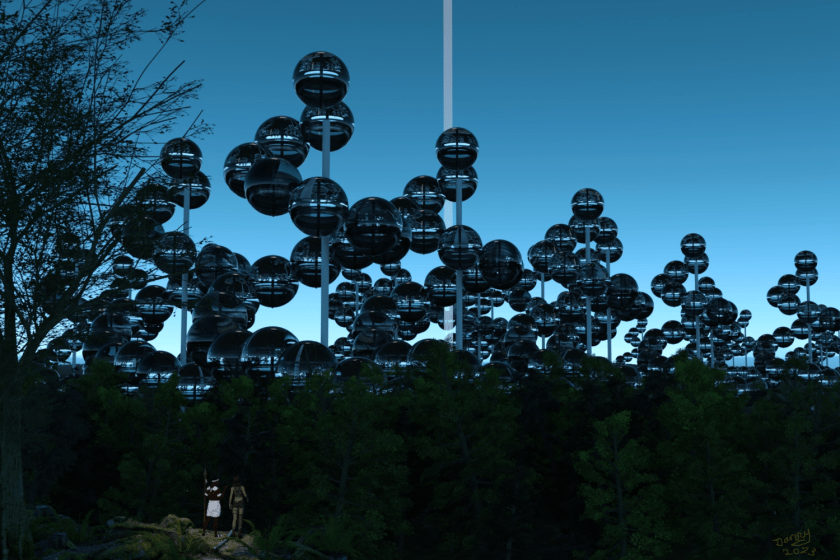
Within the Jungle is an ancient city of magnificent, 200m diameter crystal globes, each containing 20 story buildings. Long fallen into ruin and chaos internally and infested with deadly creatures and mad godlings, the city nevertheless looks beautiful and pristine from the outside.
This module contains maps to allow the game master to know the details of everyone of the quarter of a million units, hundreds of walkways, stair wells and elevator shafts in the city. The many different monstrous creatures, crazed robots, primitive and bestial tribal factions, raiding groups from the jungle beyond and great powers that infest the city are laid out so the game master can run exploration and politics together as desired. And through it all clues to a series of mysteries about the city and its origins.
Electric Gods : Terribilis Arbores
Beyond the jungle is a realm of gentle, rolling hills with beautiful, temperate forests. Well, some of the trees are less temperate than others. They aren’t so nice. Actually they are downright scary.
This will be the first module to deal with locations outside the Jungle. Hopefully one of many.
The Hide and Seek Toolkit
A toolkit for hiding things in a space and searching for them, setting an ambush or a trap and looking out for them, and trying to hide a trail and tracking that trail. This toolkit will lean heavily on the Uncertain Action checks.
Also in the Works
There is a dice roller chat bot for Discord. It hasn’t got a full time web presence yet but is available for online play test from time to time.
Keep watching this page for changes! If you haven’t already, then go get yourself a copy of the All Us Gamers rule PDFs! These are all available as “Pay what you want”. That means you can get them for free and if you think they are worth it then you can buy them again for some actual money (and thanks if you do 🙂 ).
Play testing of Electric Gods has demonstrated a need for some changes to On Aptitude.
Firstly “Enablers”. These are things that a character can learn that allows them to act as if they have enabling skill for carrying out a skilled task or a specialized task. So a person trying to speak a foreign language they have no prior learning for would be unable to really use it, but with an enabler for that language, gained by spending some time immersed in an environment where only that language is used, then the character may gain an enabler for that language. They may then speak it with no real aptitude.
There are changes to goals, which are now entirely personal rather than group goals. This is more flexible and supports better open table play.
The way of deciding difficulty, risk and time levels for any goal is greatly tightened and more concrete. The adventure point pay outs have also been adjusted to make quickly attained goals pay out little, while longer duration goals pay out a lot more.
Released
Combat Toolkit
This is heavily being overhauled.
The ability to get a “hit” on a target is more tightly defined and unified between attacks, struggles and events. The types of explicitly described harms (injuries, stuns, stings, poisons etc) is also expanded while the procedure for managing them is unified. The healing process and medical attention sections are also reworked and tidied up.
The sections on combat struggles and operations during combat are expanded and made more explicit.
I’m working hard on a new setting release, Electric Gods, set on a run away generation star ship overrun by self concerned A.I.
And I will be running a session for up to 6 players at Bris Con at the end of April.
The people have lived in this jungle place, between the Sapphire, the river of birth, and the Jade, the river of death, for thirty years. The local god ForSevOran has cared for the people, keeping the tribal enclave clear and plentiful of food. The great god NeThronSev has avatars among the people and sees far and wisely.
It seems that the supply of AcSticks grows thin and so ForSevOran’s power wanes, and territory shrinks. It sees the dreadful Bat People, servants of ThreatThreSevTo, multiply and begin to raid out of The Past. A crisis brews.
Do the people seek to move into The Future, beyond ForSevOran’s protection? Do they counter raid the Bat People Enclaves? One family, the Kelmin, urge a move across the Jade, into the realm of SevixNinonfi, for ancient treasures lie in the land of the dead. The Macrons, under the Mind Touched Marta, say the jungle beckons across the Sapphire, where the god ThroneTwifa seeks to breach the walls of heaven.
You listen to the council of the elders, and the Seven Voice of NeThronSev. You are the young ones, some expert humans, some born as physical or mental sports, and you glance one to the other thinking the fellowship must choose a path themselves, and the adults will follow if they are wise.
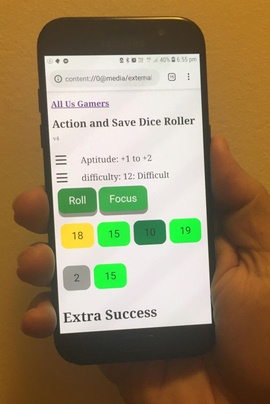
Note: It is helpful if players have a browser on their phone or device and can open https://util-space-one.w3spaces.com/augdiceroller-v5.html. This is a dice roller javascript app that knows the rules and handles the results for you, which makes for easier gameplay.
Game Master: Danny Stevens Session 3: Sunday 29th April 10am – 2pm System: All Us Gamers Genre: Post ApocalypseUp to 6 players for this session
Bris Con Game Entry
Look forward to it.
Also the Cosmic Horror rules have been getting a good work out so they will be coming out in sections in the near future.
Considerable play testing on several parallel releases leads to the creation of version 1.1 of the core. Here is the new set of core books being released over the next few months and numbering rules. Genre extensions undergoing final play tests. Settings still in progress, how they are faring.
The new 1.1 core collection
Development is still under way for Zombies Day Zero, the Horror genre extension and the Magic genre extension. Play testing has led to a lot of feedback and adjusting in the core which has led to a need for version 1.1 of the core materials.
The most notable change is the extraction of various rules into a new core book : “Operations”. Operations collects the concepts for complex actions, and sequences of actions into a cohesive method for handling multi-step tasks.
Additionally the mechanisms for cooperative action have been moved into the Inner Core and reworked to make it easier to run and to understand. The Operations book and revised Inner Core have been released. A revised On Aptitude should be out shortly, and then revised Book of Struggles and Combat Toolkit shortly after that.
The Numbering System
The core books are given version numbers in the for X.Y.Z (e.g. 1.1.0).
X : The first number is the core major version (currently there is only version one). This should only change if there is a major change in mechanism, making rules from one major version generally incompatible with rules from a different major version.
Y : The core minor version (currently version 0 or version 1) indicates that, given both rules modules have the same major version, then there may be some compatibility issues that you will need to resolve. When resolving such issues the rules from the higher version number should overrule those from lower version numbers.
Z : The document errata version. This indicates, if the major and minor version numbers are the same, that the document has been edited somewhat without changing the rules provided. There may be format fixes, clearer explanations, added examples and so forth.
The Genre Extensions
Currently being developed are the Horror and Magic genre extensions. These provide generic support for any home brew game you wish to build in those areas, and they can be combined if desired. In both cases the aim is to keep rules light, and to support clear narrative flow with broad mechanical support to avoid improvisation overload.
The Settings
Zombies Day Zero is nearing completion. It is not reliant on any genre extensions and should be easy to play with just the core and the Combat Toolkit.
Mists Of The Carpathians, set in the time of Vlad Tepes (Dracula) and allowing the magical mythology of the region to be real, continues development and play test as a labor of love. It requires a more fully developed magic genre extension so it will be a while before an initial release is ready.
Time Paths (a time travel campaign with faxed routes between time space coordinates) and Shadows Over the Galaxy (a human dominated galaxy with plenty of political intrigue and something lurking in the dark spaces) are both advancing slowly, but at a lower priority while all the other fronts are tackled.
Hello to all the new followers of this site and welcome.
The magic play test has had a bit of a hiatus as I sort out what is “structure” vs what is “too much detail”. Play tests have gone back and forth a bit with a number of different opinions offered. I’m closing in on the sweet spot.
To give myself a fun break I have gone back to producing one of my earlier product ideas for AUG, the Zombie Apocalypse Campaign. Its taking shape pretty well. A bit harder to play test because it really needs new players each time. Its getting there though.
Here is the introduction:
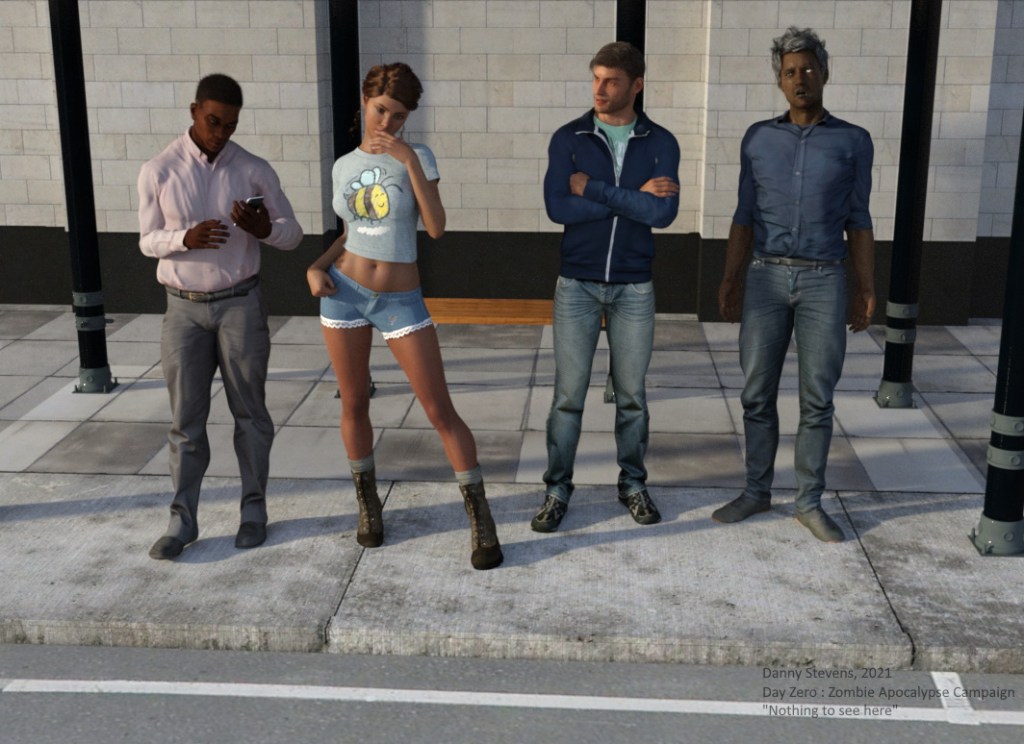
Just a normal day. On a walk to work. A woman comes running down the street yelling “He’s after me!” Behind her a young man in jeans and a torn T-Shirt, covered in blood, walks forward with malevolent intent on his face. You call to the policeman shuffling across the road, then notice his left arm is just a bloody, torn stump. “What on Earth?” you think “This is like some zombie movie!” Just then a car comes screaming around a corner, a crazy woman clinging to the roof. The car runs down the policeman and zooms on. This isn’t a movie.
Day Zero : Zombie Apocalypse Campaign is a role playing adventure set in a modern day town as the Zombie Apocalypse is just beginning. The players create regular folks as their characters and plot out how they would go about their day if nothing were happening. The game master then notes where in the city the zombies first appear, and tracks the apocalypse hour by hour until it intersects with the adventure player’s characters.
Then all hell breaks loose.
The players try to keep their characters and loved ones alive until the following dawn, and perhaps save some others. The world around them is rapidly falling apart, and characters that are run by the game master are trying to respond to what is going on, some with competent, and some with foolish methods. The adventurers may try and make common cause with them, or may find they are a complication to the goal of surviving.
How will you survive Day Zero?
Zombie Apocalypse Campaign : Day Zero
Its been a lot of fun. Massive encounter tables and interactions between the city alert level, zombie presence level and panicking survivor groups.
A framework to run a network of open table fantasy games. Each game master has one or more villages and each player has one or more characters that go on adventures across different game master’s tables.
Characters have their abilities, reputations, social rank and possessions that follow them from one game master’s village to another.
In each village they have their relationships with the local characters, and the tribes and factions in the lands around. They have quests, property and hidden treasure that are specific to a village.
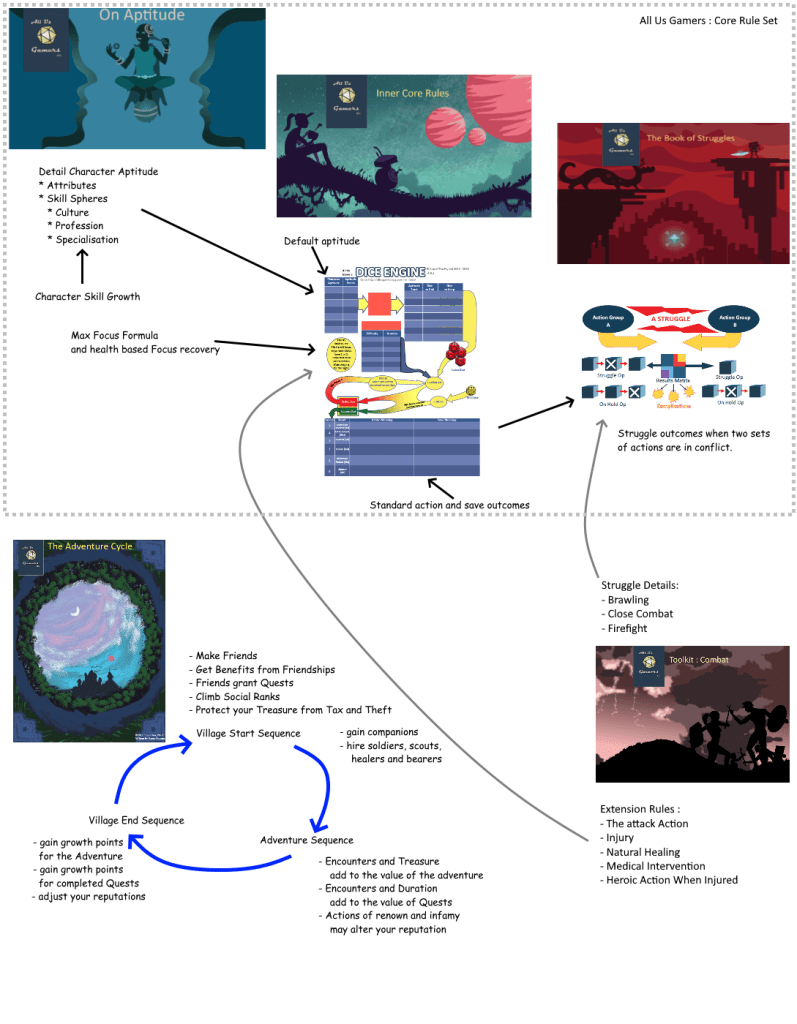
Prior to a Session the Game Master for the session will do some prep on the villagers, the adventure region and encounterable situations. An Open Table Session consists of the following distinct steps: 1) Session Set Up Sequence: Any character creation and existing character tidy up, including closed quest effects. 2) One or more Adventure Cycles as follows:
adventure cycle step 1: Village Episodes Sequence.
Focus Recovery.
pay taxes
Max 8 episodes per character (up to 2 may be reserved for step 3).
An episode always involves a single activity of a specific type. The episodes types a character may enact are: • Buy a Cottage • Buy or Sell Equipment • Buy or Sell Gems / Jewels / Art objects • Enroll Adventure Hirelings • Gain A Companion • Philanthropy • Secure Your Treasure • Seek a Quest • Seek the Right to Buy a Cottage • Socialise • Spend Growth Points • Train a Skill • Work a Profession
adventure cycle step 2: The Adventure Sequence.
Focus Recovery.
Determine quest active for each character.
Play out the adventure
Note acts of renown and infamy
adventure cycle step 3: Village Return Sequence.
Heal characters
Gain growth points for the adventure.
Gain growth points for quests closed.
Test reputations for changes.
Split treasure.
Village episodes. (Max 2 reserved from earlier)
Adventure Cycle Steps 1 and 3, in the Village, are designed to be highly structured to handle adventure “down time”, and generally contain few opportunities for full depth role play. They do, however, provide the context, motivation, and rewards for what goes on in the adventure. The adventure itself is where all the exciting role play happens.
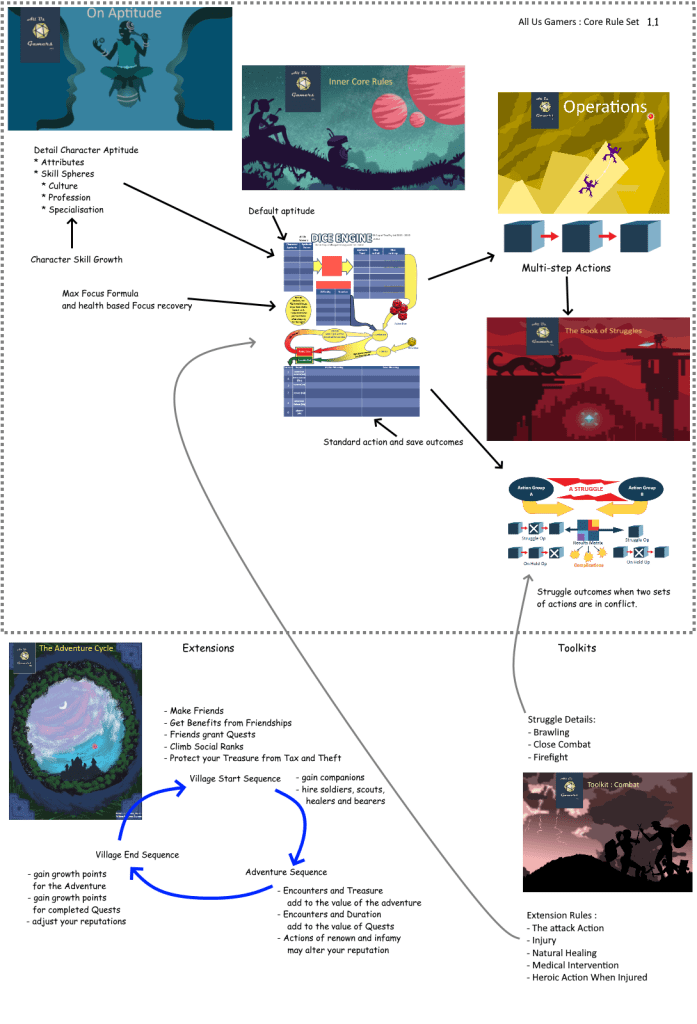
Here is how everything hangs together now.
The adventure cycle provides a play structure that uses the core rules and toolkits to provide character action and development mechanics.
There has been a lot of play testing of the Adventure Cycle, at its peak 2 game masters and 16 players in 4 session streams each week. A lot of extra stuff has been developed in draft form, such as a magic system and dungeon crawl details. These will get polished up and provided later as Adventure Cycle Plugins.
The Adventure Cycle is available now as a “Pay What You Like” PDF, 58 pages, at DriveThruRPG.
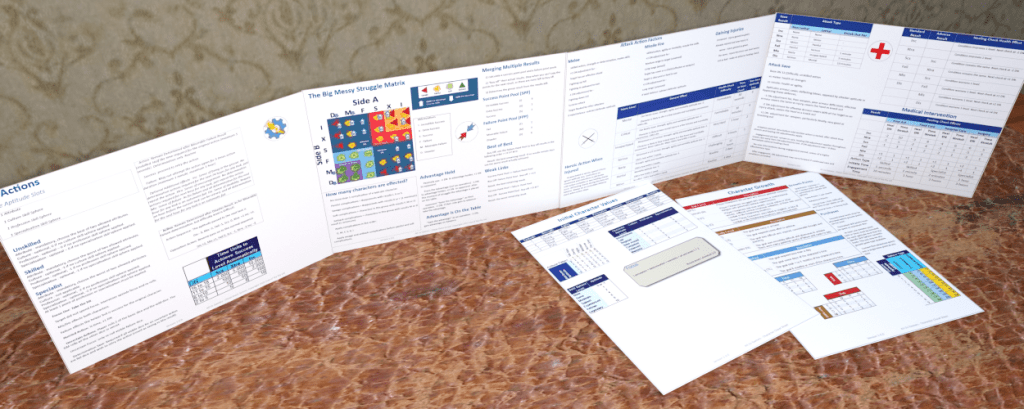
As I hit the home stretch on The Adventure Cycle I am also preparing to release a new play aid. A pdf with quick reference for building characters and a screen for helping remember the core rules and combat toolkit during play.
As often happens fate throws obstacles in the path. Power outages at inconvenient moments for example. The latest happened when I was trying to set up printed play aids to use for a photo to go with the release at Drive Thru. The printer died.
After a few moments of railing at the wyrds of fate I found another way to get the image I needed.
Having thrown together an old school style of play for running the Combat Toolkit play tests, and having 15 players regularly continuing with open table play, it seems like time to make the game structures for this type of open table into a product.
For those interested in some detailed philosophy of open table play I recommend the Open Table Manifesto.
Just as an aside, the Stealth and Investigation Toolkits are also being worked on. As with the Combat Toolkit they will be a mix of mechanics and ruling guides. We are using the Call of Cthulhu (7th Edition) RPG as a framework for play test, obviously with the AUG mechanics swapped in for the Basic Role Play mechanics.
The Open Table Chassis is a set of rules structures to allow groups of multiple players, with multiple characters to casually play with multiple game masters, potentially each with multiple home regions in a single game setting.
For this to work each play session has a single GM, using one of her home regions, and whoever is available to play, each using only one of their player characters. A fairly “board game like” rules structure is used to break an adventure down into a cycle of 3 parts.
Prep
The players have episodes in their home location where they do things covered by fairly mechanical rules: go shopping, do training, spend growth points to grow a skill, hire people to guard treasures or accompany the group on an adventure, socialize, build reputations, acquire companions and gain quests.
Adventure
The players go off to role play in a world slightly artificially structured into areas of increasing risk, and with treasures to be gained, hazards to be faced, and factions to be dealt with.
Wind Down
The players return home, gain growth points for the adventure based on treasure gained, risks and difficulties, and for quests completed based on commitment of time, risks overall and encounters braved.
In a given session of play there will be one or more complete adventure cycles. Any adventure in progress when a session runs out of time comes to an abrupt end and the wind down is flicked through.
The chassis comes with some simple book keeping, tracking which characters are the primary quest bearers for which home town, and what the character reputations are there, and tracking things that may be transferred between GM home regions, like magic items, pieces of technology, or global rank.
The first Chassis will have a baked in fantasy genre. Its treasures will be coins, gems, jewels and works of art. There will be some generic sorcery and mysticism rules (aimed at eventually being used for Mists of the Carpathians) and a collection of play structures for dungeon, wilderness, ocean and city adventuring.
A second Chassis under development will have a baked in space opera genre, with aliens, high and low tech worlds, space ships, interstellar corporations and nations and super tech artifacts left behind by “the ancients”. This will be used to lay some ground work for the Shadow Over The Galaxy setting.


 All Us Gamers Role Playing Game