Combat Toolkit 1.2.0 Released

It took a lot of play testing, and taking it out for a spin at a couple of game conventions, but finally the expanded and refined Combat Toolkit is here.

One reason for the big upgrade, that went from less than 20 pages to nearly 40, is that combat features heavily in Electric Gods, and the types of combat is wide and varied, with weapons ranging from a pointed stick to a futuristic blaster pistol, flying combatants, fights while jumping from branch to branch in the jungle canopy, and hand to hand combat on conveyor belts leading to a reclamation furnace.

All us Gamers is not a table top wargame. It is a roleplaying game. Making a system for combat that honors the distinction is not easy, and the temptation is to either go very mechanical, or entirely improvised with GM rulings.

Instead what is here is a mechanical system that gives some concrete, mechanical outcomes, embedded in an action narrative framework.

It now has a number of explicit harm types, rather than just injury, such as stings, tranquilized, paralysis. It makes poisoning a process that repeats a harm over time. That mechanism would be easily applied to diseases and radiation poisoning as well.

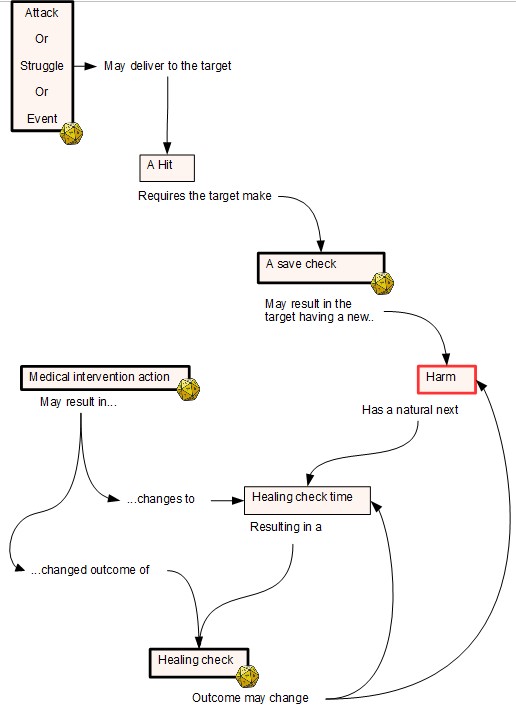
Medical intervention is tighter and smoother. It primarily allows the medics to create a group result that modifies the patients healing checks, using the system from the Inner Core.

There is a guide for weapon types and armour, giving difficulties for producing a hit, strength of application of a hit, modification of saving throw difficult by armour type, and a section on explosions for those that want grenades through to atomic blasts. This section is not comprehensive but models enough that anything else you want to add can find guidance here.

Importantly there is a set of formal “hand waving” rules that show ways to simplify, remove features you don’t feel like using and reduce game master and player book keeping. These rules have names like “Action Movie”, “Boss, Minion, Extra” and “Time Waffle”.

That is the simple mechanical process that drives the show. The art of the combat comes from its integration with the struggle and operation tools, allowing each moment of combat to be about achieving something, maneuvering, suppressing opponents, preventing and achieving operational goals and so on.

Electric Gods : the jungle bestiary

While the combat toolkit is undergoing a big overhaul and games are being played regularly as well as at conventions, the bestiary is being developed.

While the combat toolkit is undergoing a big overhaul and games are being played regularly, as well as at conventions, the bestiary is being developed.

Unlike lots of games where its all about stat blocks, this is about the role of the creatures and their behavior.

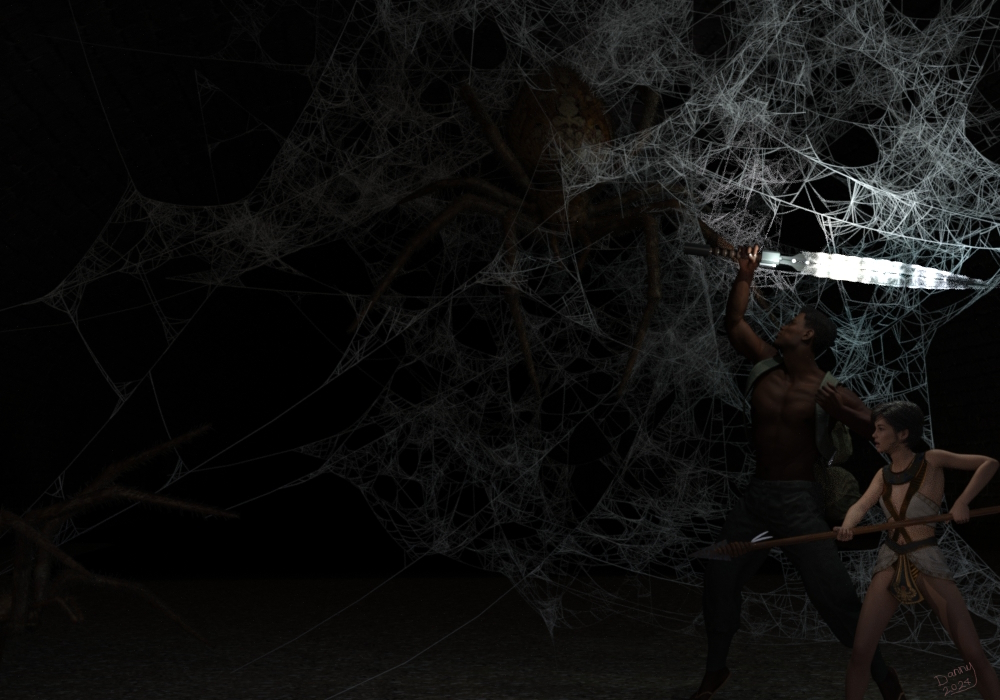
For example, take Tunnel Spiders. Their bodies are the size of large dogs. They have a built in instinct to hoard AcSticks, programmed into them long ago by the “gods” that developed them. A group carrying a lot of AcSticks are likely to be targeted by tunnel spiders that might otherwise leave them alone.

They also have an instinct to ignore a certain breed of scorpion, the size of a person’s hand, that can snatch AcSticks from the hoard and take them off to a collection place.

The spiders can move twice as fast as a running human, for about 3 combat moments but then they tire and will stop a pursuit.

Their poison is dangerous, with 2 repeat hits after injection, one each moment.

Their attack aptitude is 4. Their aptitude for hiding in dark spaces is 6.

Webs are built to capture creatures up to the size of a cat. They only slow humans down. The spiders build communal webs, with a mix of a dozen smaller spiders and one to three larger spiders. The larger spiders will often brush aside the smaller spiders and their webs to go after a good prey.
What looks like egg sacs in the webs are often wrapped up collections of AcSticks, up to 1,000 per sac.

That’s it. There isn’t much need for anything else.

There is an example of encountering Tunnel Spiders at the latest Bris Con session write up.

Mind Forged Worlds of the Cosmic Mandala

An idea on the back shelf.

There are always game ideas bubbling around in my head. This is the weirdest one. I have no idea if I will ever play test it or work on it much.

The idea is that there are many variations of the world, stretched out across a multidimensional space. The space has poles, a light side and a dark side, that are unstable, and a happy middle space. Great forces are at work to disrupt the landscape and draw it to one of the poles.

The players start out as regular people but somehow become mind forgers, with the ability to travel across realities through doors and archways, caves and passages. They get embroiled with the great powers but quickly realize they need to maintain the middle.

Each version of Earth has a reality anchor, a mail box here, a tree there. These anchors can be dominated only by changing the world in certain ways before approaching them. Moving one world can cause shifts and pressure to shift in nearby alternate versions.

That’s as far as I have got but who knows, maybe after Electric Gods is out there I may tinker with this some more.

Electric Gods : The Plan

This is a road map for the release, no dates attached. Hopefully at least two new releases within 2025. This page will update as things advance.
– version 1.2 of On Aptitude (Released 2024 04 01 🙂 )
– version 1.2 of the Combat Toolkit (Released 2024 12 20 🙂 )
– Initial release of the Electric Gods base set (will incorporate The Jungle) set for early 2025
-Initial release of Electric Gods : The Death Spines, an expansion for The Jungle.
– Initial release of Electric Gods : Terribilis Arbores, the world expands with a whole new location and environment.

Outskirts of the Death Spines

This is a road map for the release, no dates attached. Hopefully at least two new releases within 2025.

This page will update as things advance.

  1. version 1.2 of On Aptitude (Released 2024 04 01 🙂 )
  2. version 1.2 of the Combat Toolkit (Released 2024 12 20 🙂 )
  3. Initial release of the Electric Gods base set (will incorporate The Jungle) set for early 2025
  4. Initial release of Electric Gods : The Jungle (Now incorporated into the base set).
  5. Initial release of Electric Gods : The Death Spines, an expansion for The Jungle.
  6. Initial release of Electric Gods : Terribilis Arbores, the world expands with a whole new location and environment.
  7. Initial release of The Hide and Seek Toolkit

See adventure play test session reports at RPG geek.

A session of Electric Gods featured at Bris Con 2024.

The Electric Gods base set

This contains the premise of the game, all the rules needed for making an appropriate character, the setting data for the game master, and how to create your campaign. The examples will all be drawn from the Jungle setting used in the current play tests.

The adventures revolve around characters, pure humans or human sports with strange gifts, living in apparently primitive tribes.

However the gods, strange presences of glowing light hovering above the tribe’s altar, can bestow upon the tribe gifts of food and clothing, and equipment ranging from simple gardening tools to chain saws, bows and arrows through to plasma rifles, and healing medicines and technology. All the tribe has to do is supply the gods with the little white AcSticks found scattered about.

But in the wilds, beyond the protection of the gods, there are monsters of many kinds. The worst also crave the AcSticks and many will kill to gain them or keep them.

And worse still than the monsters? Other tribes, some human, some near human, some strange and exotic. Each other tribe has its own culture, its own desires, its own hatreds. Deal with them as you dare!

Survival, mystery, action, adventure, politics, all rolled into one spell binding role playing setting.

Electric Gods : The Jungle

A detailed version of the play test setting with a mountain of information about groups, the territory, equipment lists, gods of the jungle, a creature codex, some starter adventures and more.

Now incorporated into the Base Set.

Electric Gods : The Death Spires

An Expansion for Electric Gods : The Jungle

In Electric Gods : The Jungle the city is placed and described well enough for a game master to roll their own version and run with it. This module is for those game masters that want more.

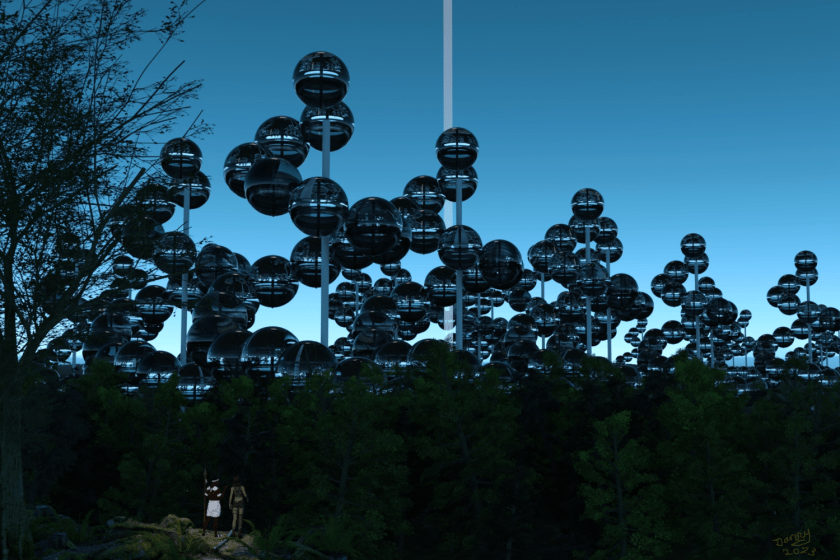
Within the Jungle is an ancient city of magnificent, 200m diameter crystal globes, each containing 20 story buildings. Long fallen into ruin and chaos internally and infested with deadly creatures and mad godlings, the city nevertheless looks beautiful and pristine from the outside.

This module contains maps to allow the game master to know the details of everyone of the quarter of a million units, hundreds of walkways, stair wells and elevator shafts in the city. The many different monstrous creatures, crazed robots, primitive and bestial tribal factions, raiding groups from the jungle beyond and great powers that infest the city are laid out so the game master can run exploration and politics together as desired. And through it all clues to a series of mysteries about the city and its origins.

Electric Gods : Terribilis Arbores

Beyond the jungle is a realm of gentle, rolling hills with beautiful, temperate forests. Well, some of the trees are less temperate than others. They aren’t so nice. Actually they are downright scary.

This will be the first module to deal with locations outside the Jungle. Hopefully one of many.

The Hide and Seek Toolkit

A toolkit for hiding things in a space and searching for them, setting an ambush or a trap and looking out for them, and trying to hide a trail and tracking that trail. This toolkit will lean heavily on the Uncertain Action checks.

Also in the Works

There is a dice roller chat bot for Discord. It hasn’t got a full time web presence yet but is available for online play test from time to time.

Keep watching this page for changes! If you haven’t already, then go get yourself a copy of the All Us Gamers rule PDFs! These are all available as “Pay what you want”. That means you can get them for free and if you think they are worth it then you can buy them again for some actual money (and thanks if you do 🙂 ).

Inner Core Rules

On Aptitude

Operations

The Book of Struggles

Combat Toolkit

Released Items

On Aptitude

Play testing of Electric Gods has demonstrated a need for some changes to On Aptitude.

Firstly “Enablers”. These are things that a character can learn that allows them to act as if they have enabling skill for carrying out a skilled task or a specialized task. So a person trying to speak a foreign language they have no prior learning for would be unable to really use it, but with an enabler for that language, gained by spending some time immersed in an environment where only that language is used, then the character may gain an enabler for that language. They may then speak it with no real aptitude.

There are changes to goals, which are now entirely personal rather than group goals. This is more flexible and supports better open table play.

The way of deciding difficulty, risk and time levels for any goal is greatly tightened and more concrete. The adventure point pay outs have also been adjusted to make quickly attained goals pay out little, while longer duration goals pay out a lot more.

Released

Combat Toolkit

This is heavily being overhauled.

The ability to get a “hit” on a target is more tightly defined and unified between attacks, struggles and events. The types of explicitly described harms (injuries, stuns, stings, poisons etc) is also expanded while the procedure for managing them is unified.
The healing process and medical attention sections are also reworked and tidied up.

The sections on combat struggles and operations during combat are expanded and made more explicit.

Lots of examples for everything.

Released

Electric Gods at BrisCon

I’m working hard on a new setting release, Electric Gods, set on a run away generation star ship overrun by self concerned A.I.

And I will be running a session for up to 6 players at Bris Con at the end of April.

The people have lived in this jungle place, between the Sapphire, the river of birth, and the Jade, the river of death, for thirty years. The local god ForSevOran has cared for the people, keeping the tribal enclave clear and plentiful of food. The great god NeThronSev has avatars among the people and sees far and wisely.

It seems that the supply of AcSticks grows thin and so ForSevOran’s power wanes, and territory shrinks. It sees the dreadful Bat People, servants of ThreatThreSevTo, multiply and begin to raid out of The Past. A crisis brews.

Do the people seek to move into The Future, beyond ForSevOran’s protection? Do they counter raid the Bat People Enclaves? One family, the Kelmin, urge a move across the Jade, into the realm of SevixNinonfi, for ancient treasures lie in the land of the dead. The Macrons, under the Mind Touched Marta, say the jungle beckons across the Sapphire, where the god ThroneTwifa seeks to breach the walls of heaven.

You listen to the council of the elders, and the Seven Voice of NeThronSev. You are the young ones, some expert humans, some born as physical or mental sports, and you glance one to the other thinking the fellowship must choose a path themselves, and the adults will follow if they are wise.

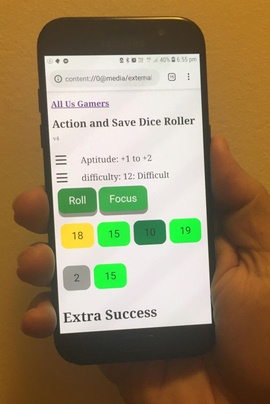
Note: It is helpful if players have a browser on their phone or device and can open https://util-space-one.w3spaces.com/augdiceroller-v5.html. This is a dice roller javascript app that knows the rules and handles the results for you, which makes for easier gameplay.

Game Master:
Danny Stevens
Session 3:
Sunday 29th April 10am – 2pm
System:
All Us Gamers
Genre:
Post ApocalypseUp to 6 players for this session

Bris Con Game Entry


Look forward to it.

Also the Cosmic Horror rules have been getting a good work out so they will be coming out in sections in the near future.

State of Play – 1.1

Considerable play testing on several parallel releases leads to the creation of version 1.1 of the core. Here is the new set of core books being released over the next few months and numbering rules. Genre extensions undergoing final play tests. Settings still in progress, how they are faring.

The new 1.1 core collection

Development is still under way for Zombies Day Zero, the Horror genre extension and the Magic genre extension. Play testing has led to a lot of feedback and adjusting in the core which has led to a need for version 1.1 of the core materials.

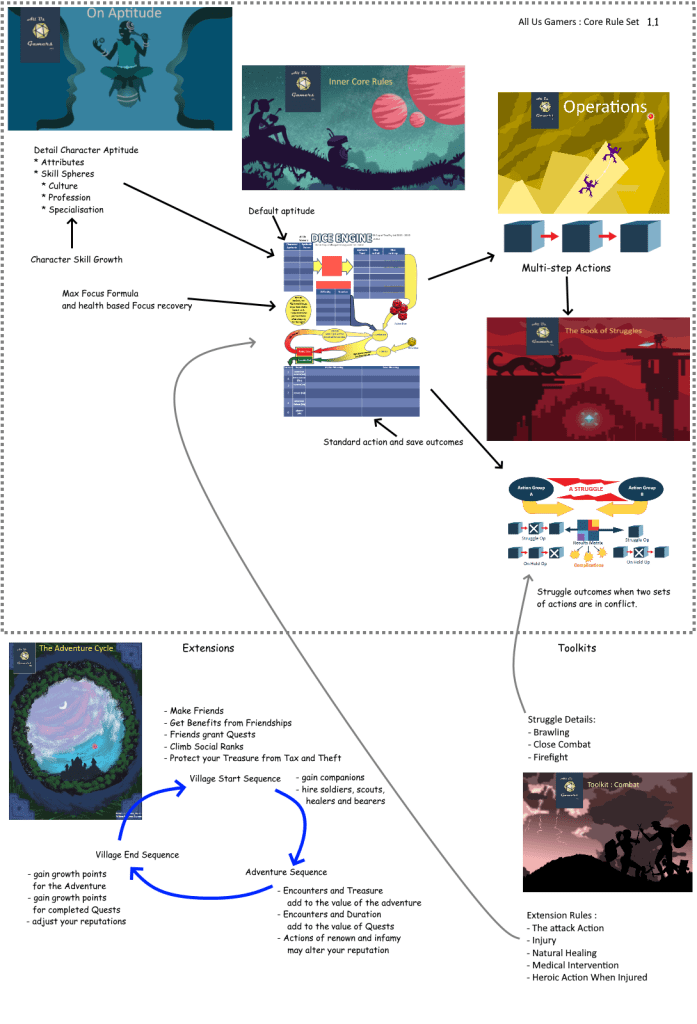
The most notable change is the extraction of various rules into a new core book : “Operations”. Operations collects the concepts for complex actions, and sequences of actions into a cohesive method for handling multi-step tasks.

Additionally the mechanisms for cooperative action have been moved into the Inner Core and reworked to make it easier to run and to understand.
The Operations book and revised Inner Core have been released. A revised On Aptitude should be out shortly, and then revised Book of Struggles and Combat Toolkit shortly after that.

The Numbering System

The core books are given version numbers in the for X.Y.Z (e.g. 1.1.0).

X : The first number is the core major version (currently there is only version one). This should only change if there is a major change in mechanism, making rules from one major version generally incompatible with rules from a different major version.

Y : The core minor version (currently version 0 or version 1) indicates that, given both rules modules have the same major version, then there may be some compatibility issues that you will need to resolve. When resolving such issues the rules from the higher version number should overrule those from lower version numbers.

Z : The document errata version. This indicates, if the major and minor version numbers are the same, that the document has been edited somewhat without changing the rules provided. There may be format fixes, clearer explanations, added examples and so forth.

The Genre Extensions

Currently being developed are the Horror and Magic genre extensions. These provide generic support for any home brew game you wish to build in those areas, and they can be combined if desired. In both cases the aim is to keep rules light, and to support clear narrative flow with broad mechanical support to avoid improvisation overload.

The Settings

Zombies Day Zero is nearing completion. It is not reliant on any genre extensions and should be easy to play with just the core and the Combat Toolkit.

Mists Of The Carpathians, set in the time of Vlad Tepes (Dracula) and allowing the magical mythology of the region to be real, continues development and play test as a labor of love. It requires a more fully developed magic genre extension so it will be a while before an initial release is ready.

Time Paths (a time travel campaign with faxed routes between time space coordinates) and Shadows Over the Galaxy (a human dominated galaxy with plenty of political intrigue and something lurking in the dark spaces) are both advancing slowly, but at a lower priority while all the other fronts are tackled.

Magic n Zombies

Hello to all the new followers of this site and welcome.

The magic play test has had a bit of a hiatus as I sort out what is “structure” vs what is “too much detail”. Play tests have gone back and forth a bit with a number of different opinions offered. I’m closing in on the sweet spot.

To give myself a fun break I have gone back to producing one of my earlier product ideas for AUG, the Zombie Apocalypse Campaign. Its taking shape pretty well. A bit harder to play test because it really needs new players each time. Its getting there though.

Here is the introduction:

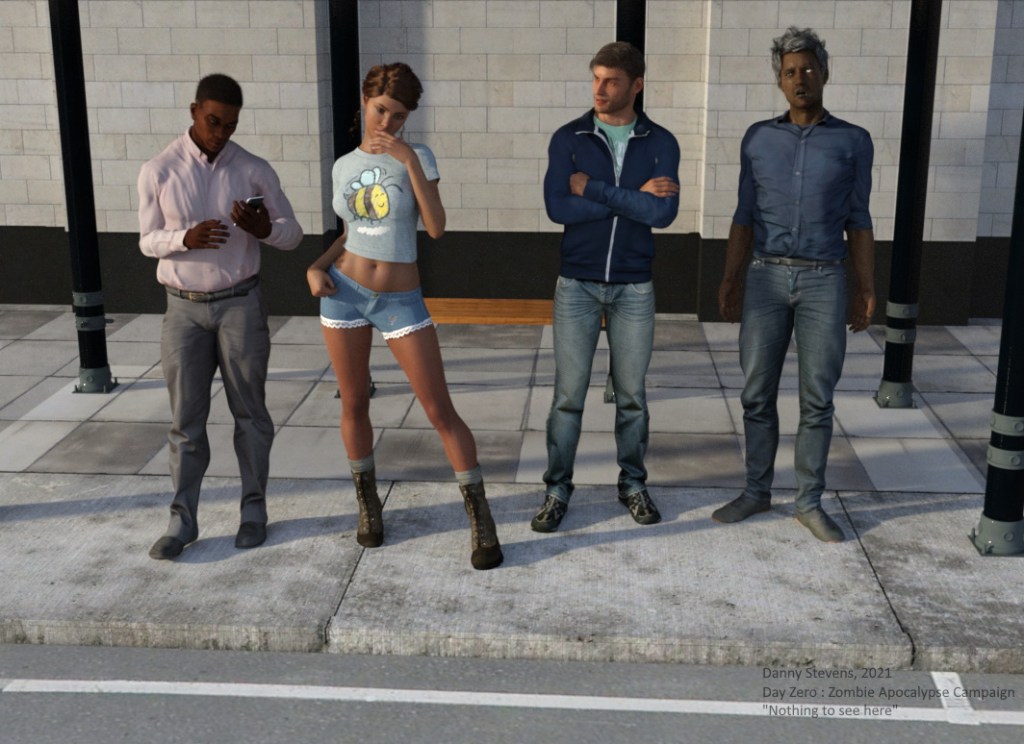
Just a normal day. On a walk to work. A woman comes running down the street yelling “He’s after me!” Behind her a young man in jeans and a torn T-Shirt, covered in blood, walks forward with malevolent intent on his face. You call to the policeman shuffling across the road, then notice his left arm is just a bloody, torn stump. “What on Earth?” you think “This is like some zombie movie!” Just then a car comes screaming around a corner, a crazy woman clinging to the roof. The car runs down the policeman and zooms on. This isn’t a movie.

Day Zero : Zombie Apocalypse Campaign is a role playing adventure set in a modern day town as the Zombie Apocalypse is just beginning. The players create regular folks as their characters and plot out how they would go about their day if nothing were happening. The game master then notes where in the city the zombies first appear, and tracks the apocalypse hour by hour until it intersects with the adventure player’s characters.

Then all hell breaks loose.

The players try to keep their characters and loved ones alive until the following dawn, and perhaps save some others. The world around them is rapidly falling apart, and characters that are run by the game master are trying to respond to what is going on, some with competent, and some with foolish methods. The adventurers may try and make common cause with them, or may find they are a complication to the goal of surviving.

How will you survive Day Zero?

Zombie Apocalypse Campaign : Day Zero

Its been a lot of fun. Massive encounter tables and interactions between the city alert level, zombie presence level and panicking survivor groups.

Prototype Play Test 4 – Spells of Imposition

Getting others to agree or be obedient by overcoming their will.

Change of Approach for Test 4

During these play tests a general feeling has built up that the casting descriptions should not be so specific. By making them detailed it tends to make people stick to the described castings and not improvise. However its the casting detail where we discover the complexity of the spell being cast.

There are general principles however of range, duration, and difficulty that can surround and support improvised rulings.

For this play test we are dropping the specific example castings entirely, even for the previous detailed ones, to see how play goes with just the enfolding specific structures and spell intents. Please give feedback as to how this works for your play style, particularly if you are a game master.

General Rules

A spell is cast on one or more targets. Its intent is to get them to act in some way, agree to an idea or change their emotions. Targets with sorcery profession or specialisation in spells of imposition turn this in to a struggle.

Where a struggle occurs with multiple spell casters or multiple targets then the rules for the struggle are weakest link for the casting side of the struggle and best of the best for the target side of the struggle.

If a target is willing to receive an imposition then there is no need to test the spell casting, it may be considered an automatic success with the standard casting time and requirements.

Focus must be available to maintain spell effects as usual. If a group has produced the effect then each member of the casting group must keep a focus engaged in the maintaining of the spell. If a member of the group drops out then a struggle opportunity occurs between the remaining group and the targets.

Generally to maintain imposed focus requires some kind of contact between caster and target if they are beyond line of sight.

Residual vulnerability or resistance occurs after a spell of imposition has been used against a target, willing or unwilling. Such vulnerability or resistance has an effect on the difficulty of casting against the target in future attempts by the same caster. It lasts for a time beyond the termination of the spell as indicated below. If a group is involved then each member of a target group has the same vulnerability or resistance toward each member of the casting group.

If a target has such a spell cast on them again, while carrying a previous vulnerability or resistance to the same caster, then the new effect replaces the old.

Cast ResultEffect for new future Impose AttemptsDuration
Inc-4 DN to impose on target5 weeks
Xtra-2 DN to impose on target5 days
Scs-1 DN to impose on target24 hours
FailNo effect
Mis+4 DN to impose on target5 weeks
DisTarget is immune to impose attempts1 year

Where a spell is cast on a player character, and it would make the character behave in ways they would prefer not to, then ask the PC to describe how they wish to act and how they will act if the imposition holds. Then they make a save using determination against a DN based on the caster’s success (Scs DN 14, Xtra DN 15, Inc DN 17). Any success amount allows the PC to act as they described they wished to, otherwise they act the other way.

A casting can be held using focus until the effect of the imposition is properly fulfilled.

A casting can try to add others to an existing effect for the same spell at +1 complexity. On a success the targets become part of the group being held to the same imposition, supported by a single focus.

If the new targets resist the imposition then the existing imposed targets get to attempt a resisting struggle.

Details

Specialisation is Spells of Imposition.

Specific Spells for this specialisation that can be learned:

  • Agree (make the target agree to a proposal)
  • Befriend (make the target consider the caster a friend)
  • Bestill (stop the target’s movement and actions)
  • Confuse (make it hard for the target to make choices or recall things).
  • Command (have the target perform a single stated task)
  • Encourage (bonus of +2 aptitude to uses of the determination attribute while the spell continues)
  • Forbid (prevent the target from taking a specific action)
  • Forget (make the target forget a specific recent event or piece of knowledge. The spell must be focused for a day to become permanent)
  • Frighten (degrading of aptitude by -2 when the determination attribute is used, and a push to force targets to flee or hide in subsequent moments)
  • Enhance (transfer aptitude of +2 to a target where the caster has aptitude for the task)

Prototype Play Test Release 3 – Spells of Life and How to Learn Spells

This is the third in the prototype series, working toward the creation of a Magic system for use with All Us Gamers and specifically for the Adventure Cycle.

The first article in the series lays the foundation.

As with all the prototype pieces, this is unlikely to be the final form of these rules. So when the magic plugin for the adventure cycle is released much of this will probably have changed. This is just the current direction that development is taking. Play tester feedback may change it. Your feedback may change it.


This part has been slowed down by various events related to the pandemic, so its slightly cut down from the original intent. We’ll try and get expanded spell collections out later but there are still some important pieces of the magic system yet to come.


To recap the general structure of magic, it revolves around sorcery specialisations. Each specialisation is needed for a small set of spells. Each spell can have a number of ways to be cast, each with differing complexity. Spells can also combine with other spells to achieve additionalforms of casting. The specialisation provides aptitude for the casting of the spells that belong to it. The sorcery profession provides aptitude to the casting of any spell.

This prototype introduces how a character goes about learning spells.

Learning spells involves getting an “inkling” about a spell, followed by study or training and building your own spell scroll, or tome pages. Your writing can be useful when casting spells or when correcting memorisation errors with the spell.

At character creation, if your character has any magical specialisations then you may choose one, and only one, appropriate spell to have learned already, with an appropriate parchment containing your spell notes.

For a spell, where you have at least 1 aptitude in the specialisation for that spell, then the process of learning a spell is summarised as follows:

  1. Gain an “inkling” about the spell
  2. Complete 10 points of “learning” for the spell.

After those two steps are complete you will then have mastered the spell and may begin casting it. After you have an “inkling” about a spell you may try to cast it but the difficulty is always +2 more than normal casting of the spell, and failure should produce serious spell backfires.

Getting an “Inkling”

The easiest method is to spend an episode with someone who knows the spell and is willing to teach it to you, or reading the notes from a sorcerer about a spell that they know.

Other ways to gain an inkling is through experiencing the spell being cast or finding “natural clues” to the spell. (see below).

Completing Spell Learning Points

Once an inkling is gained the sorcerer must write it down. If an episode was spent gaining the inkling then the writing occurs at that time. If the inkling is gained by experiencing the spell or by natural clues then an episode in the same session must be spent writing it down. Inklings take 1 page of a tome or the a half a scroll.

It then takes the accumulation of 10 learning points to gain the spell as a known spell. Each learning point can be gained in the same way as an inkling, an episode with a knowledgeable sorcerer, reading from a sorcerer’s tome or scrolls, or by having a study episode and writing notes after having experienced the spell in the field or finding further natural clues.

Clues

Clues are something a sorcerer gains in the field about spells, and then takes home to spend an episode incorporating it into their knowledge about a spell.

The first type of clue is when the sorcerer experiences a spell being cast. When this happens during an adventure a sorcerer notes down they have a clue for the spell.

The second type is natural phenomena that give clues to spells. Here the game master decides what such clues are, making them somewhat magical and related to specific spells. For example a clue for weather spells may be an outcrop of rock that is struck by lightning when the sorcerer is present. A clue for a spell of awareness may be an enchanted cocoa tree that grows in a dark grotto. Some clues may be encountered multiple times by the sorcerer, others may be more ephemeral.

Whatever the cause, when the sorcerer gets back to the village they may use an episode to write up an inkling or a learning point for the spells they have new clues for, doing some deliberation and mental exploration at the same time. No matter how many clues are encountered for a spell during a single adventure they only count as one when the sorcerer is writing her notes. The clues don’t carry forward, and more clues will need to be gained in the next adventure. If they are not written up they are lost. So a sorcerer should often retain an episode for after the adventure.

For example the rock being struck by lightning when a sorcerer is present gives them a clue, which they go home and write up. In subsequent adventures they may visit the same rock and take note of the landscape, or the weather that day, returning home with yet another clue. And so on.

Episodes with another Sorcerer

Most sorcerers charge the equivalent of 1 gold crown (100 pennies) per episode spent learning from them. Estimate other costs for learning tools accordingly. e.g. A complete set of scrolls about a spell represents about 10 gold crowns worth of learning. However because of their reusable nature they will probably fetch at least twice that when sold privately, five times that when sold publicly.

Spell Casting Failures

When a spell casting is failed with a Miserable Failure or Disaster result then there are some negative impacts for the spell caster. To determine the impact make a Spell Failure Save.

Spell Failure Save. Difficulty based on level of spell failure : Mis = DN 12, Dis = DN 14. Use mentality. Results:

I – Immune to spell cast failure effects for this spell during the rest of this session.

X – no effect.

S – Spell misremembered and unusable. 1 learning point must be achieved to re-learn this spell.

F – Spell misremembered and unusable. 2 learning points must be achieved to re-learn this spell.

M – Spell misremembered and unusable. 4 learning points must be achieved to re-learn this spell.

D – Spell misremembered and unusable. 6 learning point must be achieved to re-learn this spell. Additionally there is a spell backfire

Backfires

Backfire applies the spell effects to the caster, or to targets the caster would not want to effect, at the game master’s discretion. If focus is possible then the backfire forces focus. The duration, unless otherwise broken, will be random d20/2 moments and the spell caster cannot release the focus for that time.

Struggles may still be used to cancel or take over the backfired spell. The sorcerer who cast the spell cannot avoid struggling to keep the backfire going, but is not required to use focus on the struggle. An ally may choose to take over the back fire via a struggle just so they may dismiss it.

Spells Marked “No Save”

Many spells are marked as “No Save”. This means, if unopposed in a struggle, they affect the target as described. Magical struggles can still be used to oppose such spells.

Spells That Require Touch

Some spells are cast to effect a target that must be touched by the caster. Some spells allow touch to be a choice when cast, touch always being less complex than distance casting.

A touch spell does not need to be immediately applied after casting. It can be held ready on the fingertips by allocating a focus to keep it active until the spell is dismissed or discharged. As usual the focus is not used up by this, but may only be applied to one spell casting at a time.

If the target is trying to avoid the touch then there is a physical struggle, with the touch landing only if the sorcerer gains an Advance. The sorcerer must maintain focus until that time. If the target gains an Advance then the spell breaks and the casting is lost.

Spells That Require Focus to Maintain Once Cast

Several spells can keep their effects going against a target only by the use of focus. If the spell is initiated by touch or at targets within line of sight then if the caster wishes to be able to maintain focus when the target is no longer in line of sight, the casting of the spell is +1 complexity. If the spell is not cast with extra complexity then the focus breaks when the target is out of line of sight.

Don’t forget that other sorcerers may detect a spell maintained by focus and start a struggle over the spell.

Specialisation: Life Spells

Life Spells are spells that alter or effect living things with corporeal bodies in some way that alters their biology.

Spell of Awareness

Casting: Magical Drowsiness

Complexity : 1 target = 1. 2-3 targets = 2. 4-6 targets = 3. 7 – 10 targets = 4. If all the targets are tired then reduce complexity by 1 (minimum 0).

Target : in line of sight.

Cast Time : 6 seconds.

Duration : as long as focus is maintained.

No save.

While the spell is in effect, any action by the target has the following effect applied to it:

  • the target may not voluntarily use focus.
  • After the results are determined, and the target has at least 1 focus available, then one focus is exhausted with no effect on the result.
  • After the results are determined, and the target has no focus available, then the target must re-roll all their success dice once, and determine if they remain successes or become failures, then recalculate the action outcome.

Casting : Enchanted Sleep

Complexity : 1 target = 1. 2-3 targets = 2. 4-6 targets = 3. 7 – 10 targets = 4. If all the targets are tired then reduce complexity by 1 (minimum 0). If all the targets are under a magical compulsion to be drowsy reduce the complexity by 2 instead (minimum 0).

Target : in line of sight at the beginning of the spell cast and for at least half the spell casting time.

Cast Time : 1 hour : normal complexity, 30 minutes : +1 complexity, 1 minute : +2 complexity, 6 seconds : +3 complexity.

Duration : 1 hour enchanted sleep, extended by maintaining focus even if the target is no longer in line of sight. After enchanted sleep ends target will naturally sleep for 3 hours longer.

No save.

When cast successfully the targets fall into an enchanted sleep. Beings in an Enchanted sleep must make a DN 14 save, worst of determination or health, to respond to being awakened by any normal means.

Casting : Magical Awaken

Complexity : 1 target = 1. 2-3 targets = 2. 4-6 targets = 3. 7 – 10 targets = 4. If any target is in Enchanted sleep and there is a sorcerer maintaining it with focus then a struggle must be used to try and break their spell and advance this one.

Target : in line of sight.

Cast time: 6 seconds.

Duration: immediate.

No save.

All targets come fully awake when the spell is cast successfully.

Casting : Alert

Complexity : 1 target = 1. 2-3 targets = 2. 4-6 targets = 3. 7 – 10 targets = 4. If none of the targets are tired then reduce complexity by 1.

Target : in line of sight.

Cast Time : 6 seconds.

Duration : as long as focus is maintained and target remains in line of sight.

No save.

Target has any exhausted focus restored when spell is cast. While the spell remains focused on them the target need not use focus to re-roll fail dice on a result of failure or success. This applies even if the target has no available focus. Focus is exhausted for use in other results as normal. Focus that becomes exhausted while this spell is in effect remains so until they are restored by some other means such as rest, or a new casting of this spell is applied.

Spell of Bodily Health

Neutralise Poison / Suspend animation / Fertile / Barren

Casting : Lay on Hands

Complexity :

Injury is Minor, Nasty, Painful or Serious : 1

Injury is Incapacitated or Critical : 2

Injury is Mortal : 3

Target : touch

Cast Time : 6 seconds.

Duration : immediate

No save.

Touch a person with an injury. When successfully cast that injury heals by 1 level and sets a new healing check time.

While the spell is being cast any normal healing check is put on hold. If the cast fails then the healing check is made as normal immediately. If the spell is a success the sorcerer may bring on the healing check immediately or have it deferred to the next check time.

Casting : Sting

Complexity : 1

Target : touch

Cast Time : 6 seconds.

Duration : Immediate on touching the target.

If the target is touched they immediately gain a Serious wound as if from a weapon. Armour has no effect.

Casting : Smite

Complexity : 2

Target : touch

Cast Time : 6 seconds.

Duration : Immediate on touching the target.

No Save

If the target is touched they immediately gain a Critical as if from a weapon. Armour has no effect.

Casting : Paralyse

Complexity : 3

Target : touch

Cast Time : 6 seconds.

Duration : Immediate on touching the target, then ongoing saves at intervals.

No Save

If the target is touched they are immediately paralysed. Armour has no effect. A paralysed character may not voluntarily move limbs or speak. They collapse to the ground and are helpless.

The caster may maintain focus to hold them in this state.

When there is no focus being applied then every minute the target may make a save with the worst of health or determination at DN 14. A success breaks the spell.

Casting : Stop Poison

Complexity : 2

Target : touch

Cast Time : 6 seconds.

Duration : Immediate on touching the target.

No Save

When cast on a being that is poisoned the poisoning immediately halts and the target is no longer poisoned. Any lasting effects of the poison up to this point remain and must be dealt with.

Spell of The Senses

These spells alter a targets ability to sense through one of the five senses (sight, sound, touch, taste, smell). The sense to effect must be nominated by the caster when the spell is cast.

Casting : Improve Sense

Complexity : 1

Target : touch, or Line of sight at +1 complexity.

Cast Time : 6 seconds.

Duration : Immediate and focus.

No Save

The target has +2 aptitude when performing an action that relies on the specified sense.

Casting : Diminish Sense

Complexity : 1

Target : touch, or Line of sight at +1 complexity.

Cast Time : 6 seconds.

Duration : Immediate and focus.

No Save

The target has -2 aptitude when performing an action that relies on the specified sense

Casting : Prohibit Sense

Complexity : 2

Target : touch, or Line of sight at +1 complexity.

Cast Time : 6 seconds.

Duration : Immediate and focus.

No Save

The target cannot use the specified sense at all.

Prototype Play Test Release 2 – Magical Struggles

This is a second in the prototype series, working toward the creation of a Magic system for use with All Us Gamers and specifically for the Adventure Cycle.

This prototype relies on The Inner Core rules, On Aptitude, The Book of Struggles, the injury system in the Combat Toolkit and the spell system from the previous prototype article.

As with the previous prototype chunk, this is unlikely to be the final form of these rules. When the magic plugin for the adventure cycle is released much of this will probably have changed. This is just the current direction that development is taking. Play tester feedback may change it.

Play testers, and a commenter on Facebook, have noted some appearance of complexity in the previous spells notes. Feedback is useful and is so noted. There is already a partially streamlined version and the visual chart in particular is undergoing some tidy up and enhancement to make the fairly simple step of working out a spell casting needed, and its cost, quite obvious with no mental gymnastics required. That will be re-published in a while.

On the To Do list:

0 complexity spells.

Spell Specialisations:

  • Imposition – Getting others to agree or be obedient by overcoming their Will.
  • Enchanting – imbuing things with magical properties and Will of their own.
  • Life – spells that alter or effect living things.
  • Transform – change living and material things to different forms.
  • Knowledge – spells about knowing and informing.
  • Force – spells of physical force to hold, lift, push, or break things.
  • Elemental Force – Manipulating, creating and dispersing elemental material.

Please send detailed feedback to stranger@strangeflight.com, along with your full name as you would like it to appear on my acknowledgements list in the about page (https://allusgamersrpg.com/about/).

This release is about giving characters the ability to interfere with the casting of spells, and of spells that have been cast and are being maintained by focus. A sorcerer can detect spell casting and focus, and may attempt to take over the spell to either close it down or redirect it. Other sorcerers may join in the struggle over a spell to help out either side.

Detection of Spells

When a sorcerer is casting a spell, or actively managing a spell including using focus to sustain a spell, another sorcerer may detect the spell if all of the following apply:

  • the effect of the spell is, or will be, in line of sight of the detecting sorcerer.
  • the detecting sorcerer has at least 1 aptitude in the specialisation for the target spell, or 3 aptitude in the sorcery profession.
  • the detecting sorcerer has at least 1 available Willpower.

Effect of Detection

If there is currently no struggle over the spell, the detecting sorcerer may initiate one against the caster.

If there is a struggle in progress over the spell the detecting sorcerer may join in on one side or the other.

If the detecting sorcerer has no focus available then they don’t know the exact spell being cast, the target of the spell (if any), who is casting it, or their amount of available Willpower.

If one focus is available to the detecting sorcerer then they will know the spell and its target.

If two or more focus are available to the detecting sorcerer then they also know who the spell caster is and how much Willpower they have available.

Struggle Complications

During a magical struggle the complications have these effects:

Savage – a psychic punch – exhaust 3 Willpower as if required for a spell cast.

Painful – a psychic shove – exhaust 1 Willpower

Soft – miscalculate – DN +2 for 1 moment

Setback – fumble the powers – DN +2 for 3 moments

To continue participating in the struggle each moment a sorcerer must have either control of the spell or at least 1 available Willpower.

Pre-Cast struggle

A pre-cast struggle is when the struggle begins before the cast action is resolved. The struggle will be to go ahead with or prevent the spell, or to control the spell from the moment of casting.

If a pre-cast struggle begins within one minute of the time before the casting action is resolved, then the first struggle moment is at the time of the casting action, otherwise the struggle will run in six second moments.

Prior to the cast action itself an advance means either the caster may continue to attempt the cast or the opposition blocks the cast and it must be restarted if the caster still wants to cast the spell.

At the time of the cast, an advance by the caster means the spell is cast at the level of success the caster just achieved. An advance by the opposition means the caster must expend the base Willpower for the spell but the opposition may cancel the spell or take the spell over act as if they themselves had cast the spell. Only one person may be the caster.

If the struggle has not advanced at the moment of casting then the casting is delayed for a six second moment and the struggle goes another round.

If the caster runs out of the necessary base Willpower before the spell is cast, then the spell cast halts immediately with no effect.

Post-Cast Struggle

A post-cast struggle occurs after a spell has been successfully cast and before its effects cease to be actively managed due to spell duration or focus. The goal will be to maintain or take control of the effects of a spell in progress, or to shut the spell down.

The default struggle moment is 6 seconds.

On an advance by the sorcerer currently in control of the spell they may direct the spell behaviour. If they need available focus but have run out then the spell dissipates.

On an advance by the opponent then control of the spell changes hands and the opponent may direct spell behaviour. Again, if they need available focus but have run out then the spell dissipates.

If the struggle continues then the spell proceeds on autopilot, not directed by a sorcerer specifically. If the controlling sorcerer has run out of focus and it is needed to sustain the spell then the spell dissipates.