As play testing continues there is bound to be some changes to previous releases. Two have recently come up as the magic system has been being tested.
On Aptitude – Slow, Meticulous Actions
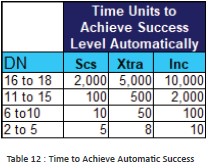
This mechanism was designed as a way to avoid dice rolling when someone could just declare they were taking their time to get it right. With the magic system players have wanted to use this to just be sure of a bare success when summoning a weather pattern, however the original values were just too onerous. So we have slimmed down the time multipliers to make it more usable.
The play screen has also been updated with these new values.
The Adventure Cycle – Reputations
The reputation system is great for shaping “in the field” play. However as we played on we found that, as well as generosity and honesty, players wanted reputations for mercy, justice, bravery and a host of other detailed things. Too many of these and things get diluted and nitpicky. So after some variations and trials we have settled on a reputation of “Benevolence”, which encompasses the previous reputations of honesty and generosity and also the other good, or bad, acts in the field.
Reputations like quest, hirelings and companion treatment remain, since they are tied to specific transactions in the game system.
The character sheets have been updated accordingly.
Future System Impact
Part of the future design includes Mysticism, which involves mastering relationships with the incorporeal spirits of the magic world. The initial intent was that fine tuned reputations would be important to them. However this has been revised so that spirits have their own specific behavior likes and dislikes, which they will try to directly observe, enhancing or detracting from the relationship with them.
A prototype part of the magic spells rules. Play test it. Full rules will be released on DriveThru as usual.
This is a first in what I hope to be a series. When developing parts of All Us Gamers I generally restrict revealing work in progress to those people I directly play test with. However the body of players around the world has grown, and this chunk of work is quite large and sprawling, so its time to start releasing playable prototype fragments for anyone to pick up and try out.
This prototype relies on The Inner Core rules, On Aptitude and the injury system in the Combat Toolkit.
This is unlikely to be the final form of these rules. When the magic plugin for the adventure cycle is released much of this will probably have changed. This is just the current direction that development is taking. Play tester feedback may change it.
Additional pre releases may include the 0 complexity spells and magical struggle rules, where competing sorcerers may try to dismiss, divert or subvert each others spell casting.
If you do try this out please send detailed feedback to stranger@strangeflight.com, along with your full name as you would like it to appear on my acknowledgements list in the About page.
This release is about giving characters the ability to cast weather spells. A considerable amount of the magic infrastructure will not be appearing here.
The aim is for a weather sorcerer to be able to call on specific spells, like casting a tornado into existence, when the prevailing weather is right. If the weather is not right then the sorcerer can spend will power on altering the weather to windy, and then throw the tornado. Also multiple sorcerers can work together in series, one shifts the weather from still to breezy, another takes it from breezy to windy and then a more masterful sorcerer can take the breeze and build a tornado from it.
Casting spells is an action, so subject to dice rolls normally. However the rules for taking extra time to achieve a result, found in On Aptitude, should be used quite often by sorcerers to avoid the downside of failure when there is no urgency or pressure on the base casting time.
Lets start.
Spells A spell is the method by which a character may impose their will on matter, energy and the will of others at a distance.
Sorcery Characters may have a profession of Sorcery. It will provide for lots of actions eventually, including initiating magical struggles, but here it is only of help with providing aptitude for casting spells.
Force Magic Characters may have a specialisation of Force Magic. That is for providing specialist aptitude for spells that impose the characters will on matter and energy.
Force Magic Spells There are many spells planned to work with the force magic specialisation, but for now I’m only providing three weather related spells. The existence of well defined spells is important for play. In an Adventure Cycle open table network only the published spells can be allowed. This does not mean that play groups at dedicated tables cannot allow the creation of new spells. When they do they should use the published spells as guidelines for the style, scope and power of any new spells they invent. Spells also have to be learned and memorised by characters but the methods for that are not part of this release. Assume the character knows all the spells shown here if (and only if) they take the Force Magic specialisation.
Castings Specific spells enable a broad collection of ways to cast spells. The castings that are detailed are guidelines. It is expected that players may come up with other ways to cast the spells that their characters know, and the GM can adjudicate with the existing guidelines in mind. Castings have a complexity (minimum of 1). (Consider what would happen if summon hail was combined with tornado as a mixed casting. Its not detailed here. A GM should work with players to adjudicate such things)
Will Power Characters have a reusable resource, called will power. Its total is Determination + Presence + 3 x the level of Sorcery + the level of all spell specialisations (in this case only Force specialisation exists). A future profession of Mysticism will exist that provides some will power increases as well, but that is not part of this release.
Cast Action Each casting is performed as a specialist action that will exhaust some will power. Being a specialist action the character not only needs to know the spell but must have at least 1 aptitude level in either force magic or sorcery. They may have 1 skill level in one and none in the other however. Having no aptitude in Sorcery produces a -2 aptitude for the action, as does having no aptitude in Force Magic specialisation.
Result
Spell Effect Activated?
Will Power Cost
Casting Time
Inc
yes
none
x1
Xtra
yes
x1/2
x1
Scs
yes
x1
x2
Fail
no
x1
x1
Mis
no
x2
x1
Dis
no
x4
x1
Cast Action Will Power Cost When a spell cast action is made the character must have the base will power points available. The base will power required is based on the spell complexity. When the spell is cast the player checks the result at the end of the base casting time. The will power points become exhausted at that time, depending on the results in the table above. If the result causes the exhaustion of more will power than the player has available, then exhaust available focus as a substitute. If focus also becomes totally exhausted and there are will power costs still to be paid, then the caster takes a minor wound and the will power is considered paid. Will power loss occurs immediately on casting. Extra casting time called for will then engage the character in the casting task until it completes, at which point the spell effect may be enacted if the activated result is ‘yes’.
Spell Complexity
Will Power Formula
Will Power Cost
1
0+1
1
2
0+1+2
3
3
0+1+2+3
6
4
0+1+2+3+4
10
Cast Action Difficulty The difficulty of a cast action is 12 + 2 x spell complexity. Beyond this prototype there will be ways for the spell caster to reduce the difficulty using rituals, scrolls, wands and other adjuncts. For this version assume that the spell caster has obtained a -2 adjustment on the difficulty somehow.
Concentration Some spells allow concentration to be used to maintain some effect in an ongoing manner. A character can concentrate on as many spells as she has available focus points. Concentrating does not exhaust any focus. If, after exhausting some focus the character is concentrating on too many spells the character will have to stop concentrating on some of the spells. Concentration, once released or broken, cannot be regained. A new spell is cast instead. (Future magic struggle rules will allow concentration on a spell to be stolen so someone else manages the spell, or even voluntarily handed over. This is not in this release)
The Spells
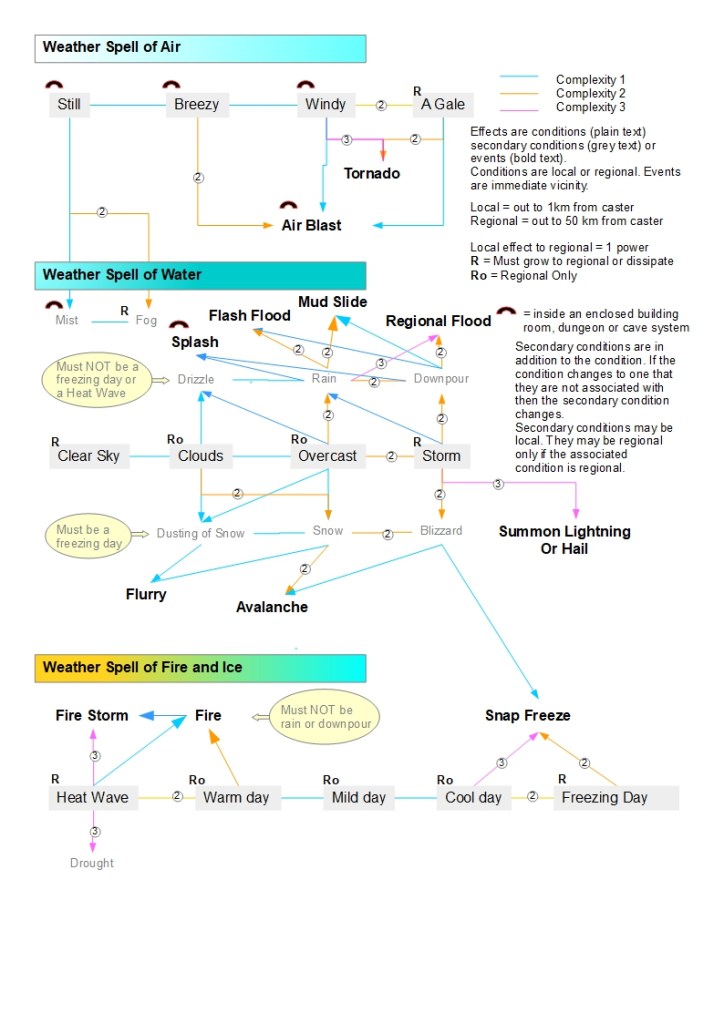
Weather spells deal with the natural weather conditions, sub conditions and particular events. There are three weather spells: “Air”, “Water” and “Fire and Ice”. Important details about the spells appear on the chart on the last page.
Dealing with the Main Natural Conditions
On any given day the weather will consist of one “Air”, one “Water” and one “Fire and Ice” condition. (Natural conditions are identified by a light grey background behind the name) Natural conditions are considered regional, an area roughly out to 50km distant from the spell caster. A spell caster may cast a local transition (expanding out from the spell caster for 1km).
A mage who knows the appropriate spell for the condition can transition the existing weather condition to another along the lines on the chart between the conditions for the spell. So the spell of air can transition still air to a breeze, and it requires 1 will power base cost. The weather spell of fire and ice can transition from a warm day to a heat wave with a base cost of 2 will power.
If the caster is making a local adjustment to the weather the base cost applies and the spell cast base time is 2 minutes. When the spell is complete the weather change finishes its transition, the caster may then concentrate on it to maintain the condition, or begin casting another transition which will also hold the current weather in effect. When the caster is no longer concentrating or transitioning then the local weather will drift back to the surrounding regional weather, taking 2 minutes per transition.
If the spell caster has a local condition in effect they may then cast the transition to that condition regionally, at the same complexity that would be required for the local transition and a base casting time of 15 minutes.
Regional transitions may also be cast directly, at 1 extra complexity for the transition cost marked on the chart, and base casting time of 10 minutes.
When regional weather has been set it will change naturally for the season. If the weather produced is unseasonal then it will drift into seasonal ranges, taking 1 hour per transition. Concentration or an additional transition casting can be used to prevent the weather drifting naturally at the regional level.
Note that some conditions can only be produced by casting at a regional level as shown on the chart. In addition some conditions can be produced locally but if not changed to regional or held in place by concentration they will rapidly dissipate.
Example
The weather is Breezy, Clouds, Mild Day. A caster wishes to make a local transition to overcast. That has a complexity of 1, a base cost of 1 power and 2 minutes to cast. The difficulty would be 12 + 2 = 14, however for this prototype we subtract 2 so it stays at DN 12. The sorcerer has 1 skill level in Sorcery and 1 in Force Spells. That means there are no specialist skill losses to aptitude and they cast with an aptitude of 2. They roll dice and get a success result, so they spend 2 power and the casting time is 4 minutes.
Now they decide to expand the local effect to regional. Complexity is still 1. Difficulty is 12, base power cost is 1, casting time base is 15 minutes. Again they get a success so this will cost 2 power and take 30 minutes.
The total power cost has been 4 and it has taken 34 minutes.
If they had decided to go directly to a regional transition from clouds to overcast the complexity would be 2, base power cost would have been 3 and base casting time 10 minutes. On a success that would have been a total power cost of 6 and a casting time of 20 minutes. There is a lower chance of failure overall since there is only one action check, compared to the two checks the other way. On the other hand the two step casting might only fail at step two, leaving the local weather to leverage again.
The Secondary Conditions
Main weather conditions may have secondary conditions. So a still main condition may have a mist or fog secondary condition, and an overcast main condition could have rain or snow secondary conditions.
Creating or removing a secondary condition works just as the castings for the main conditions. However secondary conditions are additional to the main condition, not a replacement. Also secondary conditions depend on the main conditions they can transition from. If the main condition changes to one they could not be created for then the secondary condition also dissipates. So a downpour needs a storm in progress and snow needs wither overcast weather or at least clouds.
Also note that there are main conditions in the fire and ice spell area that can determine if secondary conditions in the water area are valid. So for drizzle, rain and a downpour, it must NOT be a freezing day or a Heat Wave. For dusting of snow, snow and a blizzard it must be a freezing day.
Example
Its a cloudy, but not overcast day. The weather is freezing. To summon snow is a complexity 2 casting under those conditions. To make it snow locally only, base power cost is 3 and base casting time is 2 minutes. To go direct to regional the complexity becomes 3, base power cost is 6 and base casting time is 10 minutes.
Weather Indoors
Note that some spell casting can be done to change the conditions inside an enclosed space like a building or cave system. In such a setting then local is considered to be whatever room or chamber you are in and regional is adjoining spaces. This allows a sorcerer to summon a mist inside a dungeon, create an air blast in a room with windows open to a breeze outside, or a splash if the weather outside rainy and the splash can be brought in through a nearby opening.
The Events
Events are consequences of natural conditions pushed by will power to an extreme of effect or unexpected development. Some are momentary, others may linger naturally after the sorcerer has summoned them.
From a role play perspective these are the main game.
The events are:
Air Blast
Avalanche
Fire
Fire Storm
Flash Flood
Flurry
Mud Slide
Regional Flood
Snap Freeze
Splash
Summon Hail
Summon Lightning
Tornado
Air Blast
Summon a strong gust of wind, capable of knocking over a strong and well balanced human.
Line of sight
Requires access to moving air such as the Breeze condition.
Base casting time 6 seconds.
Duration 6 seconds or concentrate to hose around.
Living targets may save or be knocked over.
Tables and chairs etc. may be thrown about 5m and act as non-lethal projectiles.
Avalanche
Cause a large build up of snow to cascade destructively down hill.
Line of sight
Requires at least a small build up of snow which can be amplified.
Base casting time 30 seconds.
Duration as long as it takes for the avalanche to find its resting point.
The progress of the avalanche may be guided somewhat by the sorcerer as long as they maintain concentration.
The snow from a tree can be dropped on targets near it and built to a non-lethal attack that will probably constrain the targets for a moment.
Small amounts of snow can be built into a downhill cascade that will knock targets off their feet and carry them along some distance causing non lethal damage. The spell amplifies the amount of snow and ice in the avalanche.
Larger volumes can be turned into destructive slides that will smash building, cause highly lethal damage to living targets, carry them along great distances and probably bury them, itself a deadly situation.
Fire
Cause some tinder to catch fire using a small lightning spark from dry air.
Line of sight
Requires dry and combustible material and at least warm, dry weather condition.
Base casting time 6 seconds.
Duration as long as the fire has material to burn
The caster may constrain or accelerate the spread of the fire as long as they concentrate.
Fire Storm
Cause a small fire and then whip up flames and burning embers into a wall of flame and sparks.
Line of sight
Requires dry and combustible material and at least warm, dry weather condition. May transition between a fire and a fire storm.
Base casting time 30 seconds.
Duration 1 minute without concentration or a natural source of flammable materials.
The caster may constrain or accelerate the spread of the fire storm as long as they concentrate. It does not need more than the initial combustible materials to maintain its size, but does need new material to grow.
Most beings will need to make a determination save to move through a fire storm, saving against lethal damage at DN 12 as they step through. On a fail or worse then anything combustible they are wearing or carrying catches fire and adds to the size of the firestorm.
If the sorcerer is concentrating they may part the fire storm for one creature at a time to pass through safely.
Flash Flood
Cause a large volume of water to cascade through an area. It will erode a small path, knock over and carry items up to carriage size.
Line of sight
Requires rain or a downpour at the source of the flood.
Base casting time 30 seconds.
Duration as long as it takes for the flood to find a resting point or to spread out enough to lose its force.
The progress of the flood may be guided somewhat by the sorcerer as long as they maintain concentration.
The water from a pond can be caused to flow out at targets near it and its flood built to a non-lethal attack that will probably knock the targets over.
Streams and dry riverbeds can be built into a rushing torrents that will knock targets off their feet and carry them along some distance causing non lethal damage. The spell amplifies the amount of water in the flood.
Larger volumes of water, and smaller flash flood spell castings, can be turned into destructive slides that will smash building, cause highly lethal damage to living targets, carry them along great distances and probably drown them.
Flurry
Throw a flurry of snow at a target making it hard for them to see, possibly confusing their sense of direction, and disrupting concentration and coordination of a delicate task.
Line of sight
Requires snow or a dusting of snow. In a blizzard or gale it won’t hold and is ineffective.
Base casting time 6 seconds.
Duration 6 seconds after concentration ceases.
The flurry may be moved about at twice human running speed by a concentrating sorcerer.
Flurries can be used to douse small flames like candles or lantern lights.
Targets will need to make DN 16 saves.
Mud Slide
Cause a large build up of sodden earth to cascade destructively down hill.
Line of sight
Requires at least a small build up of mud which can be amplified.
Base casting time 30 seconds.
Duration as long as it takes for the slide to find its resting point.
The progress of the mud slide may be guided somewhat by the sorcerer as long as they maintain concentration.
The mud from an overhang can be dropped on targets near it and built to a lethal attack that will probably also constrain the targets for a moment.
Small amounts of loose mud can be built into a downhill cascade that will knock targets off their feet and carry them along some distance causing lethal damage. The spell amplifies the amount of soil and water in the mud slide.
Larger volumes can be turned into destructive slides that will smash building, cause highly lethal damage to living targets, carry them along great distances and probably bury them, itself a deadly situation.
Rock beds and tree roots will hamper mud slides, making the cast more difficult. Trees may end up coming along for the ride, making the slide more deadly.
Regional Flood
Bring about a flood in a region around 6 meters deep.
Region about the sorcerer.
Requires rain or a downpour, and will collect in valleys. Various key outlets for the water may become magically blocked or constricted by trees and boulders.
Base casting time is 2 hours.
Duration is 8 hours after the sorcerer has cast and ceased to concentrate.
Such floods are very destructive, ruining crops, damaging buildings, drowning people and livestock. Use real life flooding as a guide.
Snap Freeze
Cause a target to become frozen. This is lethal to living things and preserves food stuff. Small ponds and buckets of water may be frozen solid.
Line of sight
Requires a blizzard for lowest complexity, otherwise a cool to freezing day will do.
Base casting time 6 seconds.
Duration is as long as it takes for a target to naturally thaw in the conditions present.
Saves against this casting are at DN16, best of health or determination. Any level of success results in non-lethal damage only. A fail gives the target hypothermia (incapacitating injury). Miserable failure and disaster both result in the target freezing to death.
Splash
Gather a litre or so of water and hurl it at a target.
Line of sight
Requires rain, or a downpour.
Base casting time 6 seconds.
Duration instant.
The water flies at the target and can knock objects from someones grasp, topple items of shelves and douse flames like those in a fireplaces or on a torch. The splash can also hurl rainwater into a waiting receptacle like a bucket.
Summon Hail
Produces hail that can injure and break things like windows and pottery.
Visible area around the sorcerer or a specific 20m radius area in line of sight.
Requires a storm.
Base casting time 6 seconds.
Duration 30 seconds after the sorcerer has cast and ceased to concentrate.
Creatures hit by the hail can make DN 16 saves against non lethal damage.
When concentrating the sorcerer can get the hail to make lethal or damaging attacks against specific targets in line of sight every 6 seconds.
Summon Lightning
Lightning spears out from the storm to strike a target.
Line of sight.
Requires a storm.
Base casting time 6 seconds.
Duration instant.
Creatures hit by lightning make a DN 16 save against lethal damage using the best of health or agility. If the save is a failure or worse they are also knocked unconscious after being thrown 5 meters in a direction the sorcerer chooses.
Tornado
Create a tornado of destructive power that can be moved about as desired.
Line of sight.
Requires Windy or Gale conditions.
Base casting time 6 seconds.
Duration 6 seconds after ceasing to concentrate.
The tornado is 5m in diameter at its base.
The tornado may be moved by the caster at double human running speed.
The tornado will hurl creatures it strikes 10m away, requiring a DN 16 lethal damage save.
Small structures like test and thatched huts will be knocked over or shattered.
Loose objects struck by the tornado will be hurled about and may be hazards in their own right.
A framework to run a network of open table fantasy games. Each game master has one or more villages and each player has one or more characters that go on adventures across different game master’s tables.
Characters have their abilities, reputations, social rank and possessions that follow them from one game master’s village to another.
In each village they have their relationships with the local characters, and the tribes and factions in the lands around. They have quests, property and hidden treasure that are specific to a village.
Prior to a Session the Game Master for the session will do some prep on the villagers, the adventure region and encounterable situations. An Open Table Session consists of the following distinct steps: 1) Session Set Up Sequence: Any character creation and existing character tidy up, including closed quest effects. 2) One or more Adventure Cycles as follows:
adventure cycle step 1: Village Episodes Sequence.
Focus Recovery.
pay taxes
Max 8 episodes per character (up to 2 may be reserved for step 3).
An episode always involves a single activity of a specific type. The episodes types a character may enact are: • Buy a Cottage • Buy or Sell Equipment • Buy or Sell Gems / Jewels / Art objects • Enroll Adventure Hirelings • Gain A Companion • Philanthropy • Secure Your Treasure • Seek a Quest • Seek the Right to Buy a Cottage • Socialise • Spend Growth Points • Train a Skill • Work a Profession
adventure cycle step 2: The Adventure Sequence.
Focus Recovery.
Determine quest active for each character.
Play out the adventure
Note acts of renown and infamy
adventure cycle step 3: Village Return Sequence.
Heal characters
Gain growth points for the adventure.
Gain growth points for quests closed.
Test reputations for changes.
Split treasure.
Village episodes. (Max 2 reserved from earlier)
Adventure Cycle Steps 1 and 3, in the Village, are designed to be highly structured to handle adventure “down time”, and generally contain few opportunities for full depth role play. They do, however, provide the context, motivation, and rewards for what goes on in the adventure. The adventure itself is where all the exciting role play happens.
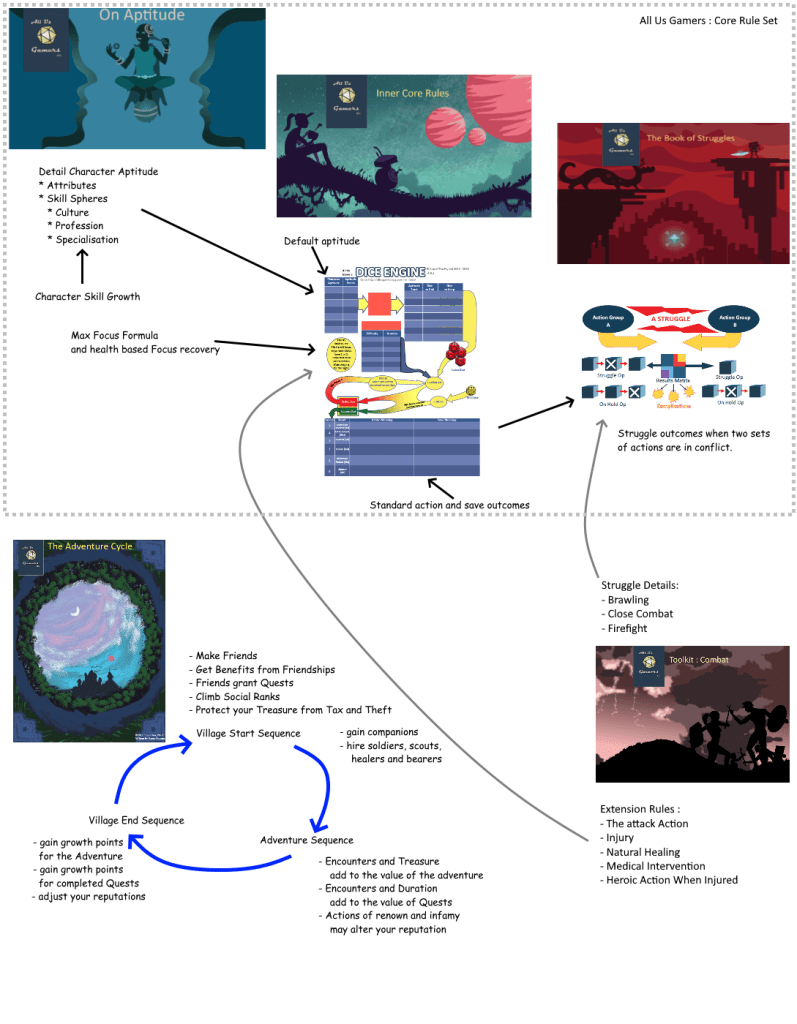
Here is how everything hangs together now.
The adventure cycle provides a play structure that uses the core rules and toolkits to provide character action and development mechanics.
There has been a lot of play testing of the Adventure Cycle, at its peak 2 game masters and 16 players in 4 session streams each week. A lot of extra stuff has been developed in draft form, such as a magic system and dungeon crawl details. These will get polished up and provided later as Adventure Cycle Plugins.
The Adventure Cycle is available now as a “Pay What You Like” PDF, 58 pages, at DriveThruRPG.
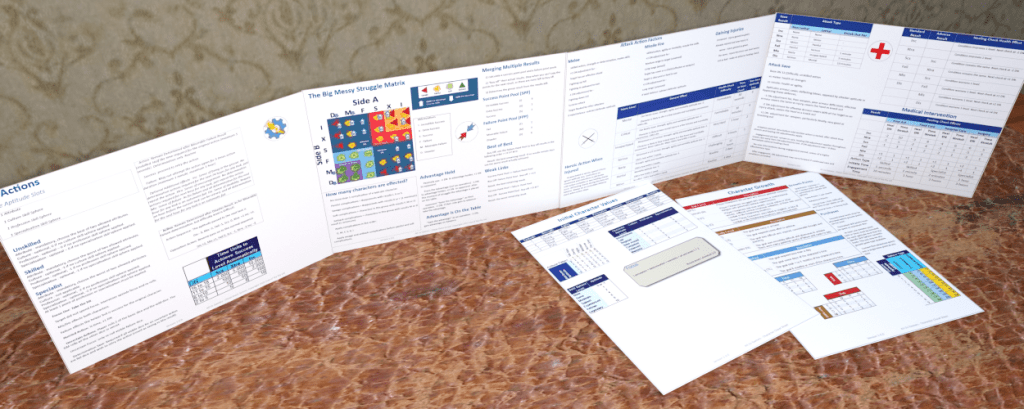
As I hit the home stretch on The Adventure Cycle I am also preparing to release a new play aid. A pdf with quick reference for building characters and a screen for helping remember the core rules and combat toolkit during play.
As often happens fate throws obstacles in the path. Power outages at inconvenient moments for example. The latest happened when I was trying to set up printed play aids to use for a photo to go with the release at Drive Thru. The printer died.
After a few moments of railing at the wyrds of fate I found another way to get the image I needed.
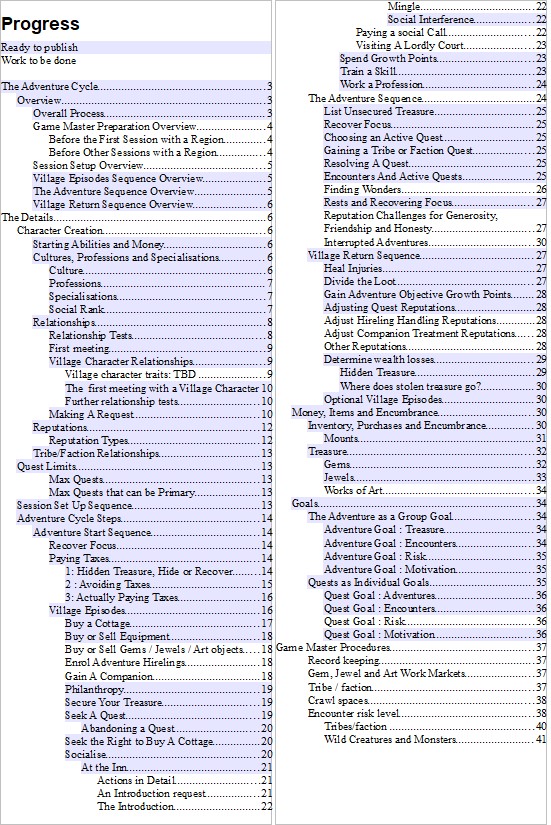
This new rule set is now entitled The Adventure Cycle. I’ve been a bit ruthless pulling out various mechanisms, to make available later as plugins. Here is the state of play for finishing up the text for the rules.
The Progress Track Using the Table of Contents
The things marked off have had some substantial play testing, as we are running four streams of play testers in groups of 3 to 6. Next up its pulling it all together into a PDF.
When On Aptitude was released it provided mechanisms for your character to have specific traits and skill sets. It also added a mechanism for improving your characters skills.
This is a common area of interest for players, how to build up their character over time. There is always the ability to gain material wealth, and now there was a way to become more skilled.
In the Open Table Chassis currently under development there are a few more formal mechanisms coming your way for elaborating your character. It all started with the idea of a formal quest and a play tester hassling the Town Watch quartermaster for a discount on swords and armour.
Lets start with the later. It presented the idea that since there are services available in the home village, like things to buy, soldiers to hire, training to be paid for, that characters relationships with villagers might be something to formalize. This is especially of value because the home village is intentionally set up as a high game structure, reduced role play, space in the game. So a series of mechanisms for making friends and influencing people within the village has started to be put together to allow some services to be available, and some to be cheaper (or more expensive or unavailable if someone doesn’t like you).
To dovetail with that is the idea of village reputations. How good are you at looking after the people you hire on for an adventure? Are you generous or stingy according to village gossip? Do you honor quests you are given? Do you succeed even at the hardest quests? So the Chassis will also have a system for formalizing reputation within the village, which will influence not only your ability to access services and get them on the cheap, but also your ability to gain and maintain friendships with the town notables. Legendary reputations may also leak across into home villages of other DMs where your character is present from time to time.
So, what about the people “out there” in the adventure spaces of the world? They can have contacts and reputations for your character too, but in a less formalized, less detailed way.
The magic system as it is developing also takes advantage of these mechanics, allowing for reputations and relationships among the sorcerers and entities in the spirit worlds. This helps with gaining access to spells and to working to get spiritual aid. The details here are still in a very preliminary stage of design.
Finally there is a nobility layer being designed, where characters can work their way into noble standing, taking on certain duties but gaining access to grand quests.
When in full flight this gives players lots of scope for developing their characters and buffing up their capabilities. And the quest system also provides accelerated skill development and strong purpose for adventuring.
The development of the core rules and toolkits has followed a principle of agile / lean production. Large chunks of work broken down into smaller, doable modules, where customer reaction could be used to adjust the design of the existing and future components. This next slab of work will go the same way.
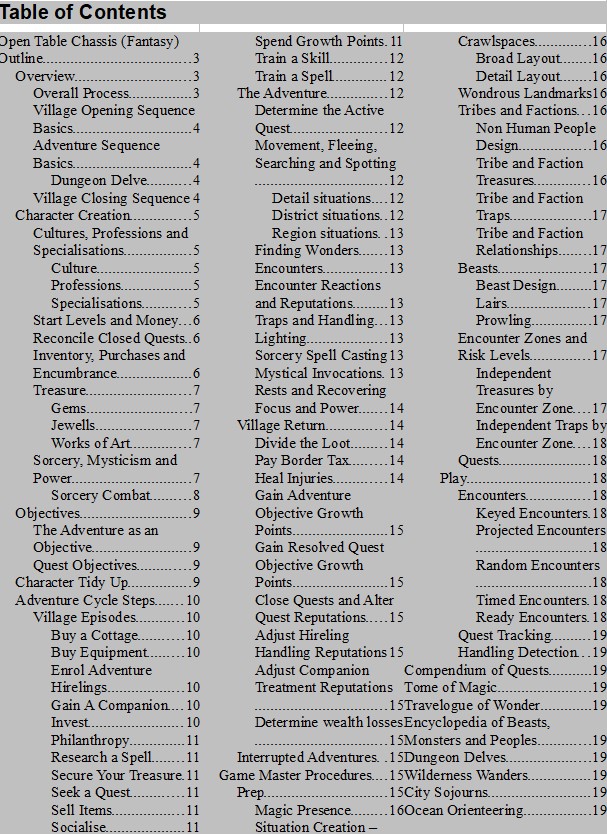
Here is the index to the Open Table Chassis – Fantasy as it has been cobbled together so far. Each section is mainly notes or bullet points in the actual document, although some is more fleshed out, having been used to play test the combat toolkit.
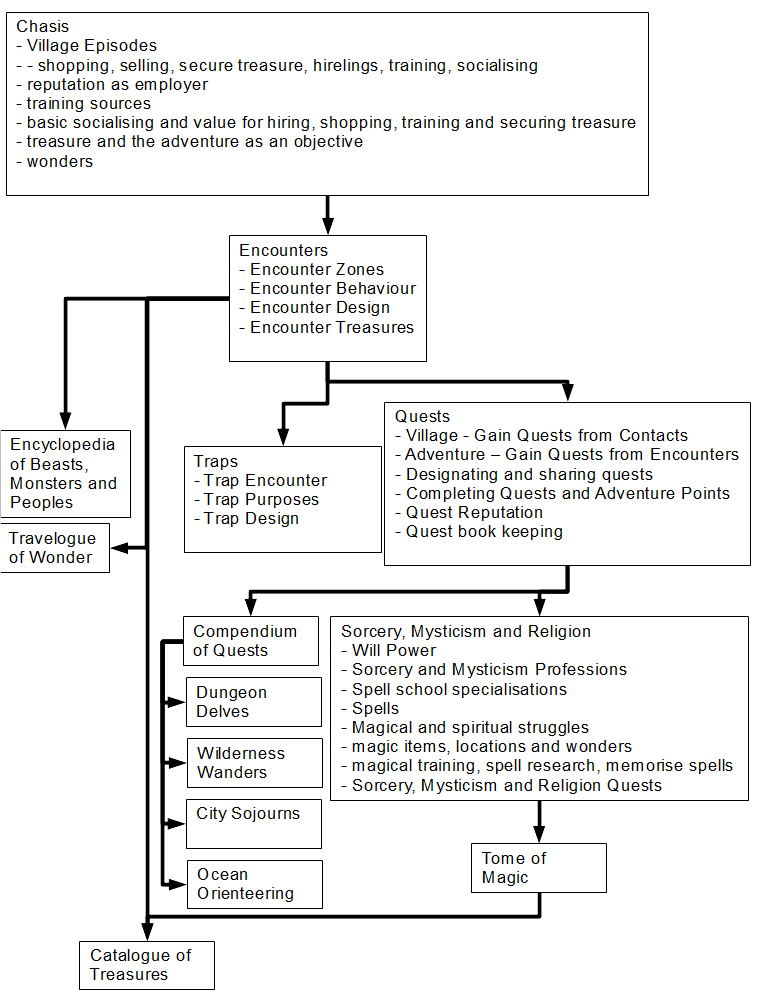
In order to get something out in a reasonable time this needs to be broken into parts, with plug in points in the core chassis for those parts to connect to.
Pulling out the magic stuff is a first item. That is getting fairly well developed but there is no point finishing it without the chassis being out there.
The Quest system is also a good candidate for break out, although its a really great and important part of the concept, the chassis can work without it. There is also a dependency from the Magic mechanics to the Quest System so the Quest System will need to get finished first.
The last 6 items in the index are all works taking the Chassis forward in more detail and adding content, so they can wait till further down the line.
The basic structure stays: Village Start, The Adventure, Village Return. The concept of reputations is important and the details for hireling and companion reputations stay, other reputations will be added to the relevant modules, such as quest reputation.
The adventure as an objective could be moved out to accompany the quest stuff, but its better if that remains in, along with encounter zones, wonders and various bric-a-brak.
Socializing in general concept stays, but there are detailed elements associated with quests and magic that get moved out into those modules.
Stuff about searching and spotting and hiding and evading should all end up in the toolkit that focuses on such things, and be part of that toolkit set.
So here is a rough breakdown.
Further down the track, we will be pulling the whole system together into a single print product, and creating an Open Game License System Reference Document for the core rules.
Having thrown together an old school style of play for running the Combat Toolkit play tests, and having 15 players regularly continuing with open table play, it seems like time to make the game structures for this type of open table into a product.
For those interested in some detailed philosophy of open table play I recommend the Open Table Manifesto.
Just as an aside, the Stealth and Investigation Toolkits are also being worked on. As with the Combat Toolkit they will be a mix of mechanics and ruling guides. We are using the Call of Cthulhu (7th Edition) RPG as a framework for play test, obviously with the AUG mechanics swapped in for the Basic Role Play mechanics.
The Open Table Chassis is a set of rules structures to allow groups of multiple players, with multiple characters to casually play with multiple game masters, potentially each with multiple home regions in a single game setting.
For this to work each play session has a single GM, using one of her home regions, and whoever is available to play, each using only one of their player characters. A fairly “board game like” rules structure is used to break an adventure down into a cycle of 3 parts.
Prep
The players have episodes in their home location where they do things covered by fairly mechanical rules: go shopping, do training, spend growth points to grow a skill, hire people to guard treasures or accompany the group on an adventure, socialize, build reputations, acquire companions and gain quests.
Adventure
The players go off to role play in a world slightly artificially structured into areas of increasing risk, and with treasures to be gained, hazards to be faced, and factions to be dealt with.
Wind Down
The players return home, gain growth points for the adventure based on treasure gained, risks and difficulties, and for quests completed based on commitment of time, risks overall and encounters braved.
In a given session of play there will be one or more complete adventure cycles. Any adventure in progress when a session runs out of time comes to an abrupt end and the wind down is flicked through.
The chassis comes with some simple book keeping, tracking which characters are the primary quest bearers for which home town, and what the character reputations are there, and tracking things that may be transferred between GM home regions, like magic items, pieces of technology, or global rank.
The first Chassis will have a baked in fantasy genre. Its treasures will be coins, gems, jewels and works of art. There will be some generic sorcery and mysticism rules (aimed at eventually being used for Mists of the Carpathians) and a collection of play structures for dungeon, wilderness, ocean and city adventuring.
A second Chassis under development will have a baked in space opera genre, with aliens, high and low tech worlds, space ships, interstellar corporations and nations and super tech artifacts left behind by “the ancients”. This will be used to lay some ground work for the Shadow Over The Galaxy setting.
Combat struggles have risk for characters who must brave death, or serious injury, to fight through the enemy in order to rescue prisoners, hold a rear guard action to let friends escape, blast away in savage firefights to defend an important position, or fire missiles to disable a deadly orbital space station.
This toolkit expands the mechanisms of The Book of Struggles to add some detailed support for combat. It provides rules extensions for managing injuries and how they heal, the method by which a combat struggle can apply injuries to characters, and the mechanisms for medical intervention.
The toolkit also supplies a set of guides for handling different situations such as brawling, close combat and firefights. Additionally you are given sets of possible non injury complications that might arise commonly in those combat situations.
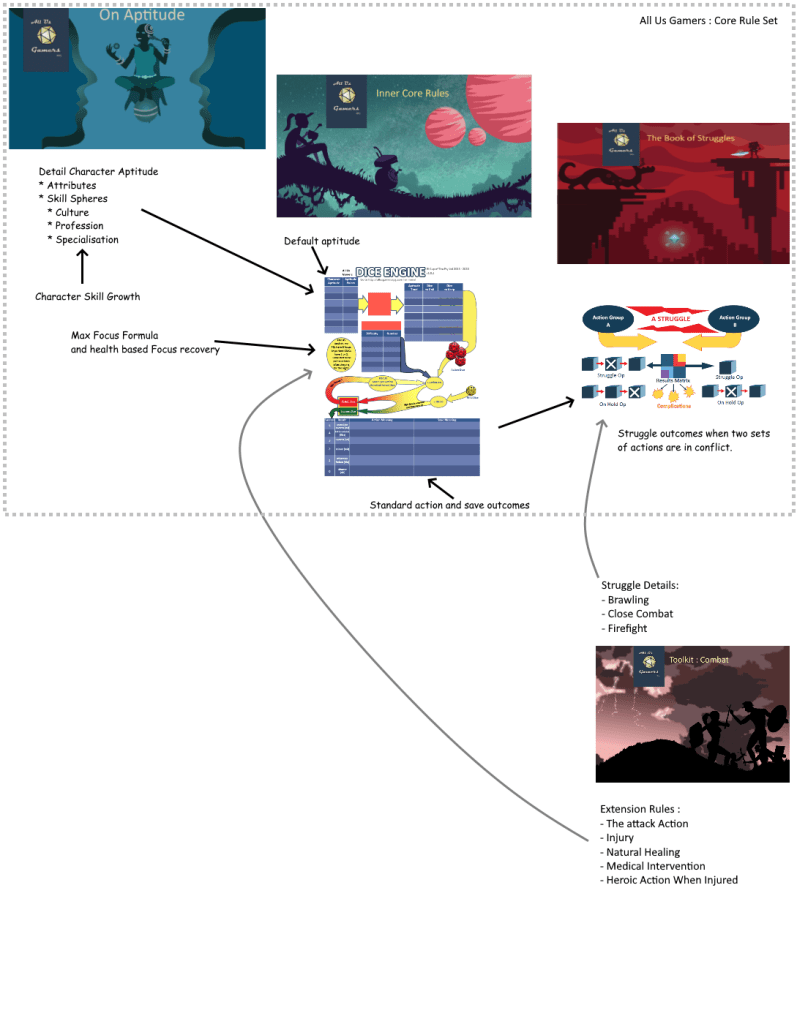
This toolkit builds on the All Us Gamers RPG core rules:
On Aptitude – adding character detail and character development
The Book of Struggles – how the base action mechanism works for conflict between characters
Combat Toolkit – the attack action, injury, healing and combat struggles
So what’s next?
Time to begin the journey into print with the first setting. The dungeon setting created for play testing the combat toolkit has become quite popular, despite being very raw, so that is going to get all the attention. Stay tuned for a kickstarter on this.
At the same time there are other toolkits to develop. The next most useful one is going to be the Stealth Toolkit, which will cover sneaking around, and trying to catch sneaks in the act.
Here is the backlog of projects for a more complete picture:
Toolkits
Stealth
Espionage
Chase and Race
Settings
Open Table Retro series – Dungeon, Wilderness, City, High Seas
Having just a bit more crunch than the core rules the Combat Toolkit has needed a bit more testing and tuning than the earlier rule segments. Can’t wait to start writing the Stealth Toolkit.
To play test the Combat Toolkit I created a throw together, old school dungeon crawl system. Such adventure style is sure to pit the players into combat situations, and it kills two birds with one stone, as some of its novel mechanics are needed for Mists of the Carpathians.
However the dungeon adventures, as an open table, have been popular. There are now multiple player groups delving into the dungeon every week or so. So the next product to work on in earnest is going to be an open table dungeon crawl. This will probably be our first foray into print, rather than pdf only, so this is going to be exciting.



 All Us Gamers Role Playing Game